Showing posts with label archaeology. Show all posts

Sunday, March 20, 2016

Sunday 3-20-16

Amateur metal detector finds ancient crucifix that may change the historical record of Christianity
 
Dennis Fabricius Holm was enjoying an afternoon off work when he found a Birka crucifix pendant in a field near the town of Aunslev, Østfyn.
“I got off early on Friday, so I took just a few hours, I went around with my metal detector and then I came suddenly on something,” Mr Holm told DK.
“Since I cleared the mud and saw the jewellery, I have not been able to think of anything else.”
On posting the find to social media, other users encouraged him to take it to a museum.
 
Malene Refshauge Beck, curator and archaeologist at Østfyns Museum said: “It is an absolutely sensational discovery that is from the first half of the 900s [10th century].”
“There is found an almost identical figure in Sweden, which has been dated to just this period.”
However, this specimen is in especially good condition and one of the most well preserved Christian artefacts found in Denmark.
It is smooth on the reverse side but has a small eye at the top for a chain.
It was probably worn by a Viking woman.
The dating of the crucifix, estimated at being from 900 – 950AD, is significant because it would indicate Danes embraced Christianity earlier than previously thought.
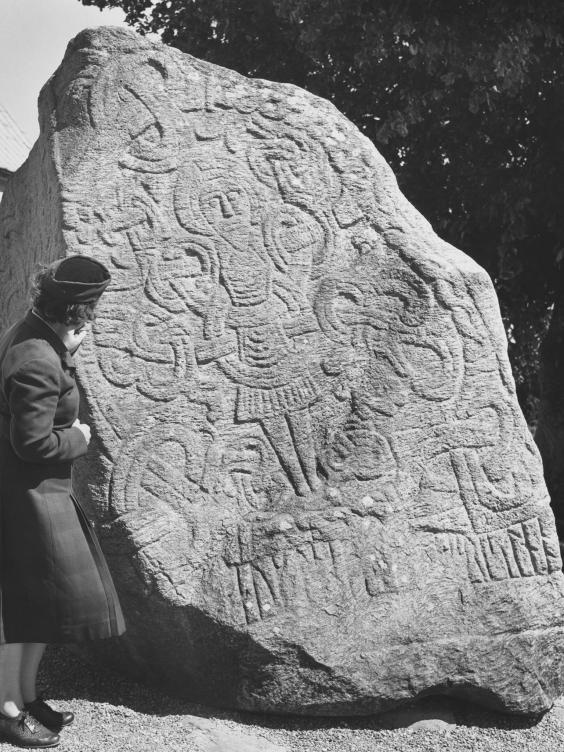
At the moment, the Jelling Stones - two large runestones erected in 965AD in Jutland - are thought to be the oldest known representation of Jesus on a cross in Denmark.
 
jelling.stone_.jpg
One of the rune stones at Jelling, Jutland. A figure with arms outstretched as if on a crucifix can be seen.
The stones, in the town of Jelling, commemorate Harald Bluetooth’s conversion of the Danes to Christianity.
Christian missionaries had been present in the country for around two hundred years before then, but had failed to convert the Vikings.  
 
Is this proof Chimps believe in God?
However, pressures from Christian trade partners to convert, and in particular, influence from the Kingdom of Germany to the south, meant that most Danes were Christian by the end of the Viking period in 1050.
“The figure can therefore help to advance the time when one considers that the Danes really were Christians,” said Ms Beck.
“Simply because one can say that the person who carried it here no doubt embraced the Christian faith.”
The impact of the find is such that the historical record of the country will need to be adjusted.
“This is a subject that certainly will have to appear in the history books in the future,” said Ms Beck.
“In recent years there has been more and more signs that Christianity was widespread earlier than previously thought - and here the clearest evidence so far.”
And as for the amateur archaeologist? 
“I’ve hardly slept!” Mr Holm said to TV2 / Fyn. 
“It has been very overwhelming. I have not yet grasped that find’s influence on Denmark's history. 
“It is hard to comprehend.”

http://www.independent.co.uk/news/world/europe/amateur-metal-detector-finds-crucifix-which-may-change-historical-record-a6936301.html


Tuesday, October 27, 2015

Tuesday 10-27-15

Month off drinking slashes risk of disease: Abstaining found to heal the liver and lower blood pressure and cholesterol levels

Drinkers should take a month off alcohol to prevent serious illness in later life, doctors warned yesterday.
They cited dramatic British research showing how abstention can heal the liver and lower blood pressure and cholesterol levels. Patients who gave up for four weeks were also at lower risk of developing cancer and diabetes.
The study is the second at the Royal Free hospital to uncover the huge benefits of staying off booze.
 
 
‘The results were staggering,’ said Professor Kevin Moore, who was involved in both experiments. ‘If you had a drug that did this it would be a multi-billion pound market.
‘There was a 40 per cent reduction in liver fat, they lost about three kilograms in weight and their cholesterol levels improved.’


In the second, larger study the London researchers looked at 102 relatively healthy men and women in their forties taking part in a ‘dry January’ campaign.
The women had been drinking an average of 29 units of alcohol a week, almost double the Government guidelines. The men were typically on 31 units, ten too many.
All had blood tests and liver scans and answered detailed questionnaires. Four weeks later the damage caused to their livers by years of heavy drinking had started to repair itself.
Their ‘liver stiffness’ - an indication of disease - had been reduced by 12.5 per cent. Their insulin resistance - a measurement of diabetes risk - had come down by 28 per cent.
Current recommendations state men should not drink more than four units of alcohol a day or 21 a week
 
They had also lost weight, their blood pressure had dropped, and many said their concentration and sleeping levels had improved. The researchers are due to publish further details, which are expected to show their risk of developing certain cancers was also reduced.
Gautam Mehta, a liver specialist who oversaw the study, said: ‘I am excited. There are some findings that will be pretty novel. It’s an important study which shows the benefit from a month’s abstinence. What we can’t say is how long those benefits are, how durable those benefits are.’
The initial results are already being examined by Department of Health officials, who are preparing new guidelines on safe drinking.
Current recommendations state women should have no more than three units a day or 14 units over a week while men should not exceed four units a day or 21 a week.
One unit is equivalent to less than half a glass of wine or half a pint of beer depending on their strength and size.
But health professionals say these limits should be reduced. They also want adults to be told to have at least two or three days off a week to allow their bodies to recover.
The Royal Free’s first experiment was on ten men and women undertaking a dry January last year.
Tom Smith of Alcohol Concern said: ‘This evidence confirms what a growing number of other studies have shown, that having even just one month off from alcohol has incredible health benefits.’
Andrew Langford of the British Liver Trust said: ‘It provides good evidence that simple behavioural change can make a real difference to the health of your liver.’


http://www.dailymail.co.uk/news/article-3289187/Month-drinking-slashes-risk-disease-Abstaining-heal-liver-lower-blood-pressure-cholesterol-levels.html

Egypt to scan pyramids, seeking new discoveries


CAIRO (AP) — Scientists will scan four of Egypt's ancient pyramids starting next month using waves, particles and thermal imaging in order to see what lies beneath their surface.
Antiquities Minister Mamdouh Eldamaty says the project will begin south of Cairo with the scanning of the so-called Bent Pyramid at Dashour, followed by the nearby Red Pyramid. Later, the two largest pyramids on the Giza plateau, those of Cheops and Chephren, will also be scanned. The structures are over 4,500 years old.
At a news conference, scientist Matthieu Klein of Canada's Laval University says his team will use infrared technology to scan several meters (yards) beneath the surface without touching the structures.
He says "there could be interesting things there, even a few meters deep, two or three blocks deep."

http://apnews.myway.com/article/20151025/ml--egypt-antiquities-83b76f046f.html

Wednesday, September 9, 2015

Wednesday 09-09-15

Europe's Biggest Bank Dares To Ask: Is The Fed Preparing For A "Controlled Demolition" Of The Market.
Why did we focus so much attention yesterday on a post in which the IMF confirmed what we had said since last October, namely that the BOJ's days of ravenous debt monetization are coming to a tapering end as soon as 2017 (as willing sellers simply run out of product)? Simple: because in the global fiat regime, asset prices are nothing more than an indication of central bank generosity. Or, as Deutsche Bank puts it: "Ultimately in a fiat money system asset prices reflect “outside” i.e. central bank money and the extent to which it multiplied through the banking system."
The problem is that the BOJ and the ECB are the only two remaining central banks in a world in which Reverse QE aka "Quantitative Tightening" in China, and the Fed's tightening in the form of an upcoming rate hike (unless the Fed loses all credibility and reverts its pro-rate hike bias), are now actively involved in reducing global liquidity. It is only a matter of time before the market starts pricing in that the Bank of Japan's open-ended QE has begun its tapering (followed by a QE-ending) countdown, which will lead to devastating risk-asset consequences. The ECB, which is also greatly supply constrained as Ewald Nowotny admitted yesterday, will follow closely behind.
But while we expanded on the Japanese problem to come in detail yesterday, here are some key observations on what is going on in both the US and China as of this moment - the two places which all now admit are the culprit for the recent equity selloff, and which the market has finally realized are actively soaking up global liquidity.
Here the problem, as we initially discussed last November in "How The Petrodollar Quietly Died, And Nobody Noticed", is that as a result of the soaring US dollar and collapse in oil prices, Petrodollar recycling has crashed, leading to an outright liquidation of FX reserves, read US Treasurys by emerging market nations. This was reinforced on August 11th when China joined the global liquidation push as a result of its devaluation announcement, a topic which we also covered far ahead of everyone else with our May report "Revealing The Identity Of The Mystery "Belgian" Buyer Of US Treasurys", exposing Chinese dumping of US Treasurys via Belgium.
We also hope to have made it quite clear that China's reserve liquidation and that of the EM petro-exporters is really two sides of the same coin: in a world in which the USD is soaring as a result of Fed tightening concerns, other central banks have no choice but to liquidate FX reserve assets: this includes both EMs, and most recently, China.
Needless to say, these key trends covered here over the past year have finally become the biggest mainstream topic, and have led to the biggest equity drop in years, including the first correction in the S&P since 2011. Elsewhere, the risk devastation is much more profound, with emerging market equity markets and currencies crashing around the globe at a pace reminiscent of the Asian 1998 crisis, while in China both the housing and credit, not to mention the stock market, bubble have all long burst.
Before we continue, we present a brief detour from Deutsche Bank's Dominic Konstam on precisely how it is that in the current fiat system, global central bank liquidity is fungible and until a few months ago, had led to record equity asset prices in most places around the globe. To wit:


Let’s start from some basics. Global liquidity can be thought of as the sum of all central banks’ balance sheets (liabilities side) expressed in dollar terms. We then have the case of completely flexible exchange rates versus one of fixed exchange rates. In the event that one central bank, say the Fed, is expanding its balance sheet, they will add to global liquidity directly. If exchange rates are flexible this will also mean the dollar tends to weaken so that the value of other central banks’ liabilities in the global system goes up in dollar terms. Dollar weakness thus might contribute to a higher dollar price for dollar denominated global commodities, as an example. If exchange rates are pegged then to achieve that peg other central banks will need to expand their own balance sheets and take on dollar FX reserves on the asset side. Global liquidity is therefore increased initially by the Fed but, secondly, by further liability expansion, by the other central banks. Depending on the sensitivity of exchange rates to relative balance sheet adjustments, it is not an a priori case that the same balance sheet expansion by the Fed leads to greater or less global liquidity expansion under either exchange rate regime. Hence the mere existence of a massive build up in FX reserves shouldn’t be viewed as a massive expansion of global liquidity per se – although as we shall show later, the empirical observation is that this is a more powerful force for the “impact” of changes in global liquidity on financial assets.
That, in broad strokes, explains how and why the Fed's easing, or tightening, terms have such profound implications not only on every asset class, and currency pair, but on global economic output.


Liquidity in the broadest sense tends to support growth momentum, particularly when it is in excess of current nominal growth. Positive changes in liquidity should therefore be equity bullish and bond price negative. Central bank liquidity is a large part of broad liquidity and, subject to bank multipliers, the same holds true. Both Fed tightening and China’s FX adjustment imply a tightening of liquidity conditions that, all else equal, implies a loss in output momentum.
 
But while the impact on global economic growth is tangible, there is also a substantial delay before its full impact is observed. When it comes to asset prices, however, the market is far faster at discounting the disappearance of the "invisible hand":


Ultimately in a fiat money system asset prices reflect “outside” i.e. central bank money and the extent to which it multiplied through the banking system. The loss of reserves represents not just a direct loss of outside money but also a reduction in the multiplier. There should be no expectation that the multiplier is quickly restored through offsetting central bank operations.
Here Deutsche Bank suggests your panic, because according to its estimates, while the US equity market may have corrected, it has a long ways to go just to catch up to the dramatic slowdown in global plus Fed reserves (that does not even take in account the reality that soon both the BOJ and the ECB will be forced by the market to taper and slow down their own liquidity injections):


Let’s start with risk assets, proxied by global equity prices. It would appear at  first glance that the correlation is negative in that when central bank liquidity is expanding, equities are falling and vice versa. Of course this likely suggests a policy response in that central banks are typically “late” so that they react once equities are falling and then equities tend to recover. If we shift liquidity forward 6 quarters we can see that the market “leads” anticipated” additional liquidity by something similar. This is very worrying now in that it suggests that equity price appreciation could decelerate easily to -20 or even 40 percent based on near zero central bank liquidity, assuming similar multipliers to the post crisis period.
 

Some more dire predictions from Deutsche on what will happen next to equity prices:


If we only consider the FX and Fed components of liquidity there appears to be a tighter and more contemporaneous relationship with equity prices. The suggestion is at one level still the same, absent Fed and FX reserve expansion, equity prices look more likely to decelerate and quite sharply.
 
The Fed’s balance sheet for example could easily be negative 5 percent this time next year, depending on how they manage the SOMA portfolio and would be associated with further FX reserve loss unless countries, including China allowed for a much weaker currency. This would be a great concern for global (central bank liquidity).
Once again, all of this assumes a status quo for the QE out of Europe and Japan, which as we pounded the table yesterday, are both in the process of being "timed out"


The tie out, presumably with the “leading” indicator of other central bank action is that other central banks have been instrumental in supporting equities in the past. The largest of course being the ECB and BoJ. If the Fed isn’t going doing its job, it is good to know someone is willing to do the job for them, albeit there is a “lag” before they appreciate the extent of someone else’s policy “failure”.
Worse, as noted yesterday soon there will be nobody left to mask everyone one's failure: the global liquidity circle jerk is coming to an end.
What does this mean for bond yields? Well, as we explained previously, clearly the selling of TSYs by China is a clear negative for bond prices. However, what Deutsche Bank accurately notes, is that should the world undergo a dramatic plunge in risk assets, the resulting tsunami of residual liquidity will most likely end up in the long-end, sending Treasury yields lower. To wit:


... if investors believe that liquidity is likely to continue to fall one should not sell real yields but buy them and be more worried about risk assets than anything else. This flies in the face of recent concerns that China’s potential liquidation of Treasuries for FX intervention is a Treasury negative and should drive real yields higher.... More generally the simple point is that falling reserves should be the least of worries for rates – as they have so far proven to be since late 2014 and instead, rates need to focus more on risk assets.
 
The relationship between central bank liquidity and the byproduct of FX reserve accumulation is clearly central to risk asset performance and therefore interest rates. The simplistic error is to assume that all assets are treated equally. They are not – or at least have not been especially since the crisis. If liquidity weakens and risk assets trade badly, rates are most likely to rally not sell off. It doesn’t matter how many Treasury bills are redeemed or USD cash is liquidated from foreign central bank assets, US rates are more likely to fall than rise especially further out the curve. In some ways this really shouldn’t be that hard to appreciate. After all central bank liquidity drives broader measures of liquidity that also drives, with a lag, economic activity.
Two points: we agree with DB that if the market were to price in collapsing "outside" money, i.e. central bank liquidity, that risk assets would crush (and far more than just the 20-40% hinted above). After all it was central bank intervention and only central bank intervention that pushed the S&P from 666 to its all time high of just above 2100.
However, we also disagree for one simple reason: as we explained in "What Would Happen If Everyone Joins China In Dumping Treasurys", the real question is what would everyone else do. If the other EMs join China in liquidating the combined $7.5 trillion in FX reserves (i.e., mostly US Trasurys but also those of Europe and Japan) shown below...

... into an illiquid Treasury bond market where central banks already hold 30% or more of all 10 Year equivalents (the BOJ will own 60% by 2018), then it is debatable whether the mere outflow from stocks into bonds will offset the rate carnage.
And, as we showed before, all else equal, the unwinding of the past decade's accumulation of EM reserves, some $8 trillion, could possibly lead to a surge in yields from the current 2% back to 6% or higher.
In other words, inductively reserve liquidation may not be a concern, but practically - when taking in account just how illiquid the global TSY market has become - said liquidation will without doubt lead to a surge in yields, if only occasionally due to illiquidity driven demand discontinuities.
* * *
So where does that leave us? Summarizing Deutsche Bank's observations, they confirm everything we have said from day one, namely that the QE crusade undertaken first by the Fed in 2009 and then all central banks, has been the biggest can-kicking exercise in history, one which brought a few years of artificial calm to the market while making the wealth disparity between the poor and rich the widest it has ever been as it crushed the global middle class; now the end of QE is finally coming.
And this is where Deutsche Bank, which understands very well that the Fed's tightening coupled with Quantiative Tightening, would lead to nothing short of a global equity collapse (especially once the market prices in the inevitable tightening resulting from the BOJ's taper over the coming two years), is shocked. To wit:


This reinforces our view that the Fed is in danger of committing policy error. Not because one and done is a non issue but because the market will initially struggle to price “done” after “one”. And the Fed’s communication skills hardly lend themselves to over achievement. More likely in our view, is that one in September will lead to a December pricing and additional hikes in 2016, suggesting 2s could easily trade to 1 ¼ percent. This may well be an overshoot but it could imply another leg lower for risk assets and a sharp reflattening of the yield curve.
But it was the conclusion to Deutsche's stream of consciousness that is the real shocker: in it DB's Dominic Konstam implicitly ask out loud whether what comes next for global capital markets (most equity, but probably rates as well), is nothing short of a controlled demolition. A premeditated controlled demolition, and facilitated by the Fed's actions or rather lack thereof:


The more sinister undercurrent is that as the relationship between negative rates has tightened with weaker liquidity since the crisis, there is a sense that policy is being priced to “fail” rather than succeed. Real rates fall when central banks back away from stimulus presumably because they “think” they have done enough and the (global) economy is on a healing trajectory. This could be viewed as a damning indictment of policy and is not unrelated to other structural factors that make policy less effective than it would be otherwise - including the self evident break in bank multipliers due to new regulations and capital requirements.
What would happen then? Well, DB casually tosses an S&P trading a "half its value", but more importantly, also remarks that what we have also said from day one, namely that "helicopter money" in whatever fiscal stimulus form it takes (even if it is in the purest literal one) is the only remaining outcome after a 50% crash in the S&P:


Of course our definition of “failure” may also be a little zealous. After all why should equities always rise in value? Why should debt holders be expected to afford their debt burden? There are plenty of alternative viable equilibria with SPX half its value, longevity liabilities in default and debt deflation in abundance. In those equilibria traditional QE ceases to work and the only road back to what we think is the current desired equilibrium is via true helicopter money via fiscal stimulus where there are no independent central banks. 
And there it is: Deutsche Bank saying, in not so many words, what Ray Dalio hinted at, namely that the Fed's tightening would be the mechanistic precursor to a market crash and thus, QE4.
Only Deutsche takes the answer to its rhetorical question if the Fed is preparing for a "controlled demolition" of risk assets one step forward: realizing that at this point more QE will be self-defeating, the only remaining recourse to avoid what may be another systemic catastrophe would be the one both Friedman and Bernanke hinted at many years ago: the literal paradropping of money to preserve the fiat system for just a few more days (At this point we urge rereading footnote 18 in Ben Bernanke's "Deflation: Making Sure "It" Doesn't Happen Here" speech)
While we can only note that the gravity of the above admission by Europe's largest bank can not be exaggerated - for "very serious banks" to say this, something epic must be just over the horizon - we should add: if Deutsche Bank (with its €55 trillion in derivatives) is right and if the Fed refuses to change its posture, exposure to any asset which has counterparty risk and/or whose value is a function of faith in central banks, should be effectively wound down.
* * *
While we have no way of knowing how this all plays out, especially if Deutsche is correct, we'll leave readers with one of our favorite diagrams: Exter's inverted pyramid.


http://www.zerohedge.com/news/2015-09-05/europes-biggest-bank-dares-ask-fed-preparing-controlled-demolition-stock-market


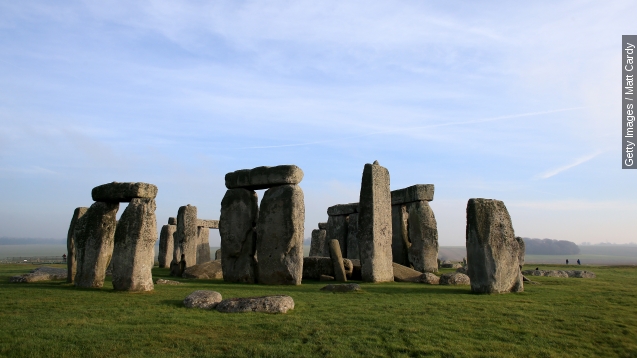
Stonehenge 'on steroids' found 2 miles away


Researchers in England just discovered a "superhenge" monument buried underground near Stonehenge. Video provided by Newsy Newslook
           
Stonehenge, the world-renowned circle of stone columns in southern England, may have had a brother.
A much bigger, older brother.
University of Bradford researchers announced Monday that they had discovered a monument of about 100 stones covering several acres thought to have been built around 4,500 years ago.
The Stonehenge Hidden Landscapes Project used remote-sensing technologies to discover the monument, which is near Durrington Walls, also known as "superhenge." Stonehenge, which is believed to have been completed 3,500 years ago, is about 2 miles away.

"What we are starting to see is the largest surviving stone monument, preserved underneath a bank, that has ever been discovered in Britain and possibly in Europe," Vince Gaffney, an archaeologist at Bradford University who leads the project, toldThe Guardian newspaper. "This is archaeology on steroids."
The evidence was found beneath 3 feet of earth. Some of the stones are thought to have stood 15 feet tall before they were toppled.
"Our high-resolution ground-penetrating radar data has revealed an amazing row of up to 90 standing stones, a number of which have survived after being pushed over, and a massive bank placed over the stones," professor Wolfgang Neubauer, director of the Ludwig Boltzmann Institute for Archaeological Prospection and Virtual Archaeology, told CNN.


"In the east, up to 30 stones … have survived below the bank whereas elsewhere the stones are fragmentary or represented by massive foundation pits," he said.
"The extraordinary scale, detail and novelty of the evidence produced by the Stonehenge Hidden Landscapes Project, which the new discoveries at Durrington Walls exemplify, is changing fundamentally our understanding of Stonehenge and the world around it," Neubauer added.

"Everything written previously about the Stonehenge landscape and the ancient monuments within it will need to be rewritten," Paul Garwood, an archaeologist and lead historian on the project at the University of Birmingham, told CNN.
The findings were announced on the first day of the British Science Festival being held at the University of Bradford.

Sunday, August 30, 2015

Sunday 08-30-15

Prayer helps

B.C. nurse sets own broken legs while trapped in car after crash on Hwy 16

WATCH: A Prince George woman is telling a remarkable story of survival after a car accident that left her at the bottom of a cliff. John Hua has her story.
Stacie Reis had made the drive between Prince George and her hometown of Kitimat countless times without incident, but that all changed last month.
The 27-year-old’s car went off the road, careening 40 feet down an embankment.
Once she got her bearings inside the flipped car, Reis’ training as a neo-natal nurse kicked in.
 
“I noticed my feet were real broken,” she said. “They were twisted to the side. My little nurse brain was like, you’ve got to straighten those up because you’re going to…lose your blood supply and then you’re going to lose your legs. I just prayed for a while and so I then picked them up and I moved them. It was really painful but I did it.”
Friends and family desperately searched for her along Highway 16 while she waited, broken and alone.
“It was a scary feeling because she was gone, she was just missing as if she disappeared from the face of the Earth,” said mother Sharon Reis.
She remained missing for 14 long hours, before friends eventually found her.
Once at the hospital, doctors told Reis the extent of her injuries: a broken sternum, ribs, and pelvis plus contusions to her heart and lungs.
As for her broken legs, doctors said the fact that she set them herself after the crash “probably played a big part in saving them.”
Reis is now on the long road to recovery, but her positive attitude has inspired friends, family and co-workers.
“I can’t imagine being hurt like that and how she has a positive look every day that she’s healing,” said co-worker Coleen Rae.
While it will be about a year before Reis walks again, the thought of getting back to the job that saved her life keeps her smiling.
“Being a patient definitely has influenced what kind of nurse I’m going to be. I think I’ll be an even better nurse when I go back.”

http://globalnews.ca/news/2172906/nurse-sets-her-own-broken-legs-after-car-crash-between-prince-george-and-kitimat/

Critics Of Bible Silenced Once Again: Archaeological Discoveries Prove Old Testament To Be Accurate

ebla tablet
This article originally appeared here.
For many years, the critics of the Old Testament continued to argue that Moses invented the stories found in Genesis. The critics contended that the ancient people of the Old Testament times were too primitive to record documents with precise details.

In doing so, these critics basically claimed that there was no verification that the people and cities mentioned in the oldest of Biblical accounts ever really existed.
The discovery of the Ebla archive in northern Syria in the 1970′s confirmed that the Biblical records concerning the Patriarchs are spot on. It was during the excavations in northern Syria that the excavating found a large library inside a royal archive room. This library had tablets dating from 2400 -2300 BC.
The excavating team discovered almost 15,000 ancient tablets and fragments which when joined together accounted for about 2,500 tablets. Amazingly, these tablets confirmed that personal and location titles in the Biblical Patriarchal accounts are authentic. These tablets are known as the Ebla Tablets.
For a long period of time, the critics of the Old Testament used to argue that the name ‘Canaan’ was used wrongly in the early chapters of the Bible. They claimed the name Canaan was never used at that specific time in history. They further accused that the name was inserted in the Old Testament afterwards, while the earliest books of The Holy Bible were not written in the times that are described.
However, with the discovery of the tablets from the northern Syria, the word the word “Canaan” does appear, contrary to the claims of the critics. The tablets proved that the term was actually used in ancient Syria during the time in which the Old Testament was written.
Additionally, the cities of Sodom and Gomorrah were also thought to be pure fiction by Bible critics. These cities are also identified in the Ebla tablets, in addition to the city of Haran. Haran is described in Genesis as the city of Abram’s father, Terah. Previous to this discovery, ‘scholars’ suspected the actual presence of the ancient city.
In addition to this, countless other archaeological findings confirm the Biblical records to be real and accurate. Some of these findings are listed below:
  • The campaign into Israel by Pharaoh Shishak (1 Kings 14:25-26) is recorded on the walls of the Temple of Amun in Thebes, Egypt.
  • The revolt of Moab against Israel (2 Kings 1:1; 3:4-27) is recorded on the Mesha Inscription.
  • The fall of Samaria (2 Kings 17:3-6, 24; 18:9-11) to Sargon II, king of Assyria, is recorded on his palace walls.
  • The defeat of Ashdod by Sargon II (Isaiah 20:1) is recorded on his palace walls.
  • The campaign of the Assyrian king Sennacherib against Judah (2 Kings 18:13-16) is recorded on the Taylor Prism.
  • The siege of Lachish by Sennacherib (2 Kings 18:14, 17) is recorded on the Lachish reliefs.
  • The assassination of Sennacherib by his own sons (2 Kings 19:37) is recorded in the annals of his son Esarhaddon.
  • The fall of Nineveh as predicted by the prophets Nahum and Zephaniah (2 Kings 2:13-15) is recorded on the Tablet of Nabopolasar.
  • The fall of Jerusalem to Nebuchadnezzar, king of Babylon (2 Kings 24:10-14) is recorded in the Babylonian Chronicles.
  • The captivity of Jehoiachin, king of Judah, in Babylon (2 Kings 24:15-16) is recorded on the Babylonian Ration Records.
  • The fall of Babylon to the Medes and Persians (Daniel 5:30-31) is recorded on the Cyrus Cylinder.
  • The freeing of captives in Babylon by Cyrus the Great (Ezra 1:1-4; 6:3-4) is recorded on the Cyrus Cylinder.
http://bravemag.com/bible-critics-silenced/

Wednesday, June 24, 2015

Wednesday 06-24-15


Google eavesdropping tool installed on computers without permission

 Privacy advocates claim always-listening component was involuntarily activated within Chromium, potentially exposing private conversation.


google 

Privacy and open source advocates complain over secret installation of audio-snooping software from Google. Photograph: Emmanuel Dunand/AFP/Getty Images

First spotted by open source developers, the Chromium browser – the open source basis for Google’s Chrome – began remotely installing audio-snooping code that was capable of listening to users.

It was designed to support Chrome’s new “OK, Google” hotword detection – which makes the computer respond when you talk to it – but was installed, and, some users have claimed, it is activated on computers without their permission.

“Without consent, Google’s code had downloaded a black box of code that – according to itself – had turned on the microphone and was actively listening to your room,” said Rick Falkvinge, the Pirate party founder, in a blog post. “Which means that your computer had been stealth configured to send what was being said in your room to somebody else, to a private company in another country, without your consent or knowledge, an audio transmission triggered by … an unknown and unverifiable set of conditions.”

The feature is installed by default as part of Google’s Chrome browser. But open source advocates are up in arms about it also being installed with the open source variant Chromium, because the listening code is considered to be “black box”, not part of the open source audit process.

“We don’t know and can’t know what this black box does,” said Falkvinge.

Opt-in or opt-out

Google responded to complaints via its developer boards. It said: “While we do download the hotword module on startup, we do not activate it unless you opt in to hotwording.”

After having identified Chromium as the culprit, developer Ofer Zelig said in a blog post: “While I was working I thought ‘I’m noticing that an LED goes on and off, on the corner of my eyesight [webcam]’. And after a few times when it just seemed weird, I sat to watch for it and saw it happening. Every few seconds or so.”

Google also blamed the Linux distribution Debian for downloading the non-open source component with Chromium automatically, rather than Google Chrome.

“The key here is that Chromium is not a Google product. We do not directly distribute it, or make any guarantees with respect to compliance with various open source policies,” Google developer mgiuca said.

Falkvinge countered Google’s explanations saying: “The default install will still wiretap your room without your consent, unless you opt out, and more importantly, know that you need to opt out, which is nowhere a reasonable requirement.” He says a hardware switch to disable the microphone and camera built into most computers is needed.

Voice search functions have become an accepted feature of modern smartphones, but their movement into the home through the smart TV, and now browser, have caused concerns over the possibility of being listened to within the home.

While most services require a user to opt in, privacy advocates have questioned whether their use, which requires sending voice recordings over the internet to company servers for processing, risks unintentionally exposing private conversations held within the home.

• Samsung’s voice-recording smart TVs breach privacy law, campaigners claim


Chinese Votive Sword Found in Georgia suggests Pre-Columbian Chinese travel to North America


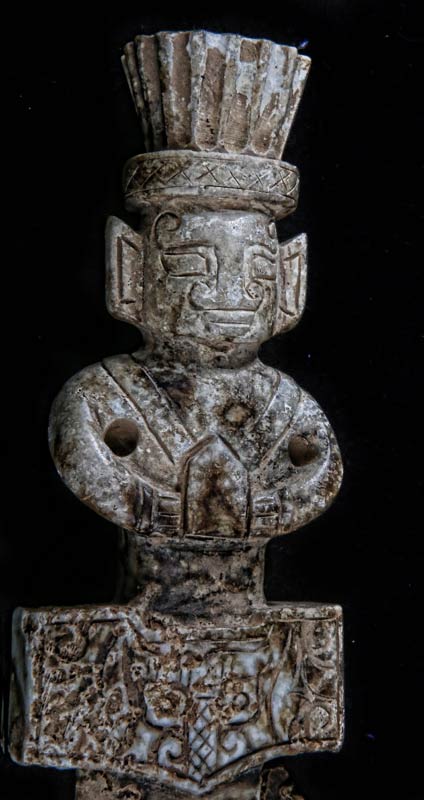
In July 2014, an avocational surface collector chanced across a partially exposed Chinese votive sword behind roots in an eroded bank of a small stream in Georgia. The 30 cm artifact is possibly a one-of-a kind find in North America and is another example in the growing list of seemingly out-of-place Chinese artifacts suggesting Chinese travel to North America in Pre-Columbian times.
The exquisite sword has preliminarily been identified as being fashioned in Lizardite and has surface features indicating it is very old. It is hoped that future testing will confirm the type of stone, and determine the source, since Lizardite deposits exist in both eastern and western hemispheres.
Answers to the when, who, and how questions remain uncertain. An attempt to determine when the soil at the extraction site was last exposed to sunlight with thermoluminescence testing procedures, was thwarted because it was determined the soil had been disturbed. There remains a small section of an unknown stranded material still attached to the sword which may be suitable for radiocarbon dating, and also select areas of surface accretions that may produce helpful information.

Chinese symbology

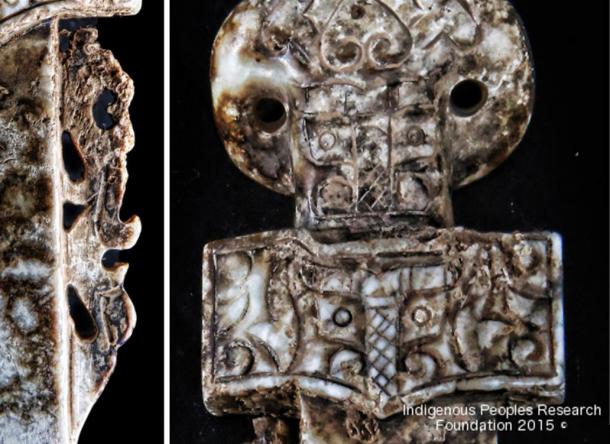
Less uncertain are the many symbols and the shape of the sword, both of which are found on jade objects from the Xia (2070-1600 BC), Shang (1600-1046 BC) and Zhou Dynasty (1046-256 BC). The dragon figure spanning a portion of the top of the blade is typical to the Shang Dynasty, as is the feathered crown. The grotesque face mask of the Taotie on the guard and handle of the sword, first appears during the Liangzhu culture (3400-2250 BC) but it is more commonly found during the Shang and Zhou periods. (Siu-Leung Lee, PhD,  personal conversation, and soon to be published paper.)
 Close up of dragon Right: Close up of Taotie in this general area. Photo courtesy of the Indigenous Peoples Research Foundation.
Left: Close up of dragon Right: Close up of Taotie in this general area. Photo courtesy of the Indigenous Peoples Research Foundation.
The dominant presence of Shang period diagnostics and the similarity of the Taotie to depictions of the Mesoamerican Olmec were-jaguar, provide clues as to when the sword was made and a general time frame for when it may have arrived in Georgia.

Chinese – Olmec connection?

The similarity of Chinese-Olmec mythology and symbolism has been the subject of scholarly debate for over one hundred years. It is perhaps no coincidence that the Olmec culture appears around 1500 BC during the beginning of the Shang Dynasty, and the first written history of China begins. It was the start of the Bronze Age resulting in ornate bronze works of art, bronze chariots and weaponry. The first Chinese script appears at this time along with extensive irrigation systems and other public works projects, all indicators of a sophisticated and advanced culture.
It was also a time in Chinese culture when Jade was more valuable than gold, and likewise with the Olmec elite who had Jade deposits located in now Honduras and Guatemala. It may not be coincidental the Olmec, during their Middle Formative period (900-300 BC), mastered the difficulties of shaping and drilling Jade (a stone so hard that it cannot be worked with steel tools), with abrasive materials into small ornamental and votive pieces. The similarities of Chinese-Olmec art is quite telling and for those interested, an excellent comparison is presented in Art and Ritual in Early Chinese and Mesoamerican Cultures, Santiago Gonzalez Villajos, 2009.
The likely introduction of Chinese concepts of rulership and a stratified society, along with their religion and symbolism no doubt altered the Olmec and later Mesoamerican groups. It was an event that would be repeated in the 16th century when Spanish Friars waded ashore carrying the cross of Christianity.
Reverse side of the votive sword. Photo courtesy of the Indigenous Peoples Research Foundation.

How did the sword get to Georgia?...some possibilities

Around 900 BC, these new Olmec cultural attributes started to spread throughout the region. There is considerable literature indicating that they served as a foundation for other contemporaneous and subsequent cultural groups, such as the Maya. Though modified by other groups to meet local needs and with changes over time, the basic concepts of the Olmecs persisted into the 16th century conquest period. Interestingly, some of these ancient concepts, such as those relating to the planting of maize, are still practiced today within certain Mesoamerican indigenous groups. It is generally believed this dispersal was a by-product of the Olmec land and coastal maritime trade routes transporting basic and exotic trade goods.
An intriguing element to this cultural phenomenon, and why it is mentioned, is that it starts around 900 BC, which as mentioned previously, is when the Olmec started making Jade ceremonial objects.
An example that illustrates the geographic extent of this cultural diffusion is the distribution of flat and cylindrical printing seals, a technology that first appears in the Mesoamerica artifact record with the Olmec. In China, printing seals first appear during the Shang Dynasty.

Olmec traditions spread north

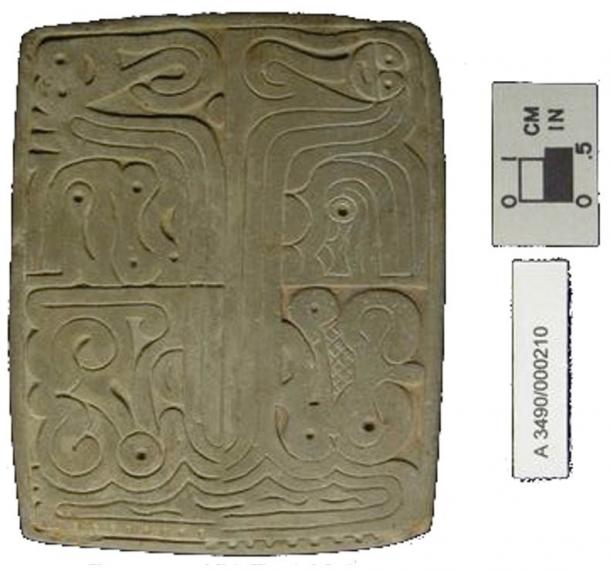
By 800 BC, the seals were in use in northern South America some 1700 miles south of the Olmec heartland, and an equal distance to the north with the Adena Culture (800 BC-1 AD) in the upper Ohio River Valley in North America. Not only did the printing technology arrive in Ohio but also Olmec art. In an unpublished research project on the Adena tablet shown below, this author found stylistic duplicates of the unique center vertical element representing the World Tree, at the Lake Chalco region south of now Mexico City and at Veracruz on the Gulf coast.
Printing Seal from the Adena Culture.
Printing Seal from the Adena Culture. Photo courtesy of the Ohio Historical Society
The arrival of seals at the beginning of the transformational mound building Adena culture, along with other evidence too numerous to include in this short article, indicates that an influential Mesoamerican group entered the region and influenced the cultural destiny of the local population. 
Returning to Georgia. In 1685, Charles de Rochefort in his chronicles regarding the Apalachites who occupied the lands in southeastern America in the 17th century, writes,
“Thefe Apalachites boaft, that they had propagated certain Colonies a great way into Mexico: And they fhow to this day a great Road by land, by which they affirm that their Forces march'd into thofe parts… The Inhabitants of the Country, upon their arrival gave them the name of Tlatuici, which fignifies Mountaineers or High-Landers...”.
Rochefort also writes, “This people [Apalachites] have a communication with the Sea of the Great Gulf of Mexico or New Spain, by means of a River”...the Spaniards have called this River Riu del Spirito Santo” [Mississippi River].
While Rochefort's observations are from after the Conquest Period, his observations highlight a geographic fact that is often overlooked or minimized in North American history. The various cultures occupying the lands of now Georgia and other States fronting on the Gulf of Mexico, along with the Caribbean Islands, Mexico, and South America, were in a circum-Caribbean region where everyone knew their neighbors. One can therefore reasonably assume that this is the reason is why ball courts and rubber balls are found in both mainland Mesoamerica and the Caribbean Islands.
Also, one cannot overlook that the Olmec and Maya had a fleet of large ocean going canoes plying the coastal waters of the Gulf region, and the logistical organization to supply the basic needs of major urban areas with population densities equal to today’s major cities. For example, salt, a basic requirement for survival in the tropics, needed in countless tons per month, was shipped from salt producing facilities in the Yucatan to known river ports stretching from the Honduran Moskito Coast to Tampico, Mexico.
Other than being a wet and scary experience with no life preservers in rough seas off the Moskito Coast, I can attest based on multiple trips, the dugout log design works very well. Even today, with the exception of Yamaha outboard motors, these vessels which have not changed in manufacture or design since the Maya, still transport tons of stacked 50 gallon barrels of gasoline, food stuffs and people into the Honduran interior.
In the Greater Antilles, the impressive Taino culture, who migrated from Venezuela starting around 400 BC, and the Caribes, were equally adept at traversing the waters of the Gulf of Mexico. Christopher Columbus makes numerous entries in his log of large Taino canoes, measuring approximately 40 to 79 feet in length, laden with trade goods and people. More noteworthy is that his log entries indicate that the Taino knew of the Calusa in Florida and the Maya on the Yucatan.
From all of this it is seems apparent that the circum-Caribbean region cultures, even in more ancient times, were connected by water and land routes, and this furnishes us a possible explanation as to how the sword and two Olmec-style pendants arrived in Georgia.
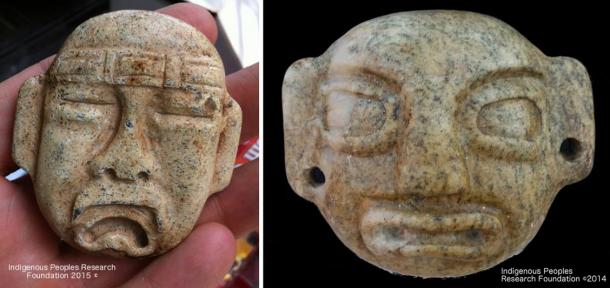
Olmec Style Pendants found in creek near Chinese votive sword.
Photo courtesy of the Indigenous Peoples Research Foundation.

So, were the Chinese in Georgia?

Part of the answer is the artifact itself. You have to ask why a person would tote around a Votive sword which by definition is an object “expressing a religious vow, wish, or desire: offered or performed as an expression of thanks or devotion to God”, if they were not Chinese.
Secondly, the sword is not the only diagnostic Chinese artifact found nearby. Chinese researcher Dr. Lee disclosed that two other ancient Chinese artifacts have been recently found within a two hour drive of the sword site. He will feature these artifacts in a forthcoming paper. Also, there has been a remarkable number of other Chinese artifacts, rock art script and symbolism located in southwestern America.
Unfortunately in the quest for accuracy in historical and archeological topics, there never seems to be enough data to reach an absolute and non-debatable answer that all can agree with. So at this time the “were the Chinese in Georgia?” question can only be answered affirmatively when there is a sufficient amount of evidence to rise above an individual's “Threshold of Believability”.

A closing comment

About 90 years, before Columbus first sailed into Caribbean waters, the Ming Chinese dispatched flotillas under the command of Admiral Zheng He on multiple voyages to the lands around the Indian Ocean to acquire exotic items and materials.
The Admiral's first expedition consisted of approximately 185 vessels:
  • 62 or 63 baoshan  or “treasure ships” were constructed for the first expedition, 440'-538' long by 210' wide, four decks, nine masts, displacing an estimated 20-30,000 tons, approximately 1/3 to 1/2 the displacement of a current large aircraft carrier.
  • Machuan or “horse ships”, 340' long by 138' wide, 8 masts, carrying horses, timber for repairs and tribute goods.
  • Liangchuan or “grain ships”. 257' long by 115' wide, 7 masts, carrying grain for crew and soldiers.
  • Zuochuan or “troop ships, 220' long by 84' wide, six masts.
  • Zhanchuan warships, 165' long, 5 masts
  • 27-28,000 estimated sailors, soldiers, translators and crew members

http://www.ancient-origins.net/artifacts-other-artifacts/chinese-votive-sword-found-georgia-suggests-pre-columbian-chinese-travel-020406#ixzz3dtj1uZOX
Follow us: @ancientorigins on Twitter | ancientoriginsweb on Facebook