Showing posts with label nuke stuff. Show all posts

Tuesday, February 23, 2016

Tuesday 02-23-16

Received an email from a friend, I did not see it in the news, they must be trying to keep it quite

Feb 20, 2016
 
The Saudis just made a shocking admission made in the international press. During an interview on RT Arabic, Dahham Al Anzi of the Kingdom of Saudi Arabia, discussed why the Arab world feel the need for Syrian President Bashar al-Assad to be removed from power. He also reaffirmed the need for a ground invasion to accomplish that goal.

While outlining the weapons of war he confirmed that the Kingdom of Saudi Arabia possess a Nuclear Bomb.
https://www.youtube.com/watch?v=uUGY6xWW8PU
 

 China Is Buying Up American Companies Fast, and It’s Freaking People Out

Here’s a story you’ll be hearing about a lot this year.
Chinese companies have been buying up foreign businesses, including American ones, at a record rate, and it’s freaking lawmakers out.
There is General Electric’s sale of its appliance business to Qingdao-based Haier, Zoomlion’s bid for the heavy-lifting-equipment maker Terex Corp., and ChemChina’s record-breaking deal for the Swiss seeds and pesticides group Syngenta, valued at $48 billion.
Most recently, a unit of the Chinese conglomerate HNA Group said it would buy the technology distributor Ingram Micro for $6 billion.


Saturday, January 3, 2015

Saturday 01-03-15

Intel files patent for real-time facial recognition system

December 30, 2014 - 
Intel recently filed an application with the United States Patent and Trademark Office for a new technology method of real-time facial detection using an image or video of the subject taken by a mobile device.
Intel Korea research engineer Wooju Ryu describes the face detection method in the U.S. Patent Application No. 20140341430, titled “Method and Device for Detecting Face, and Non-Transitory Computer-Readable Recording Medium for Executing the Method”.
Ryu writes that the method calls for the breaking up an input image into a set number of regions, then resizing those image regions and conducting both face detection and face tracking operations on the divided and resized regions.
By partitioning the input images, the individual is able to cut down the amount of time it takes for portable devices to process face detection in real time.
Intel continues to make a strong push into the biometric and wearable technology market through a series of developments and partnerships, such creating a new developer’s platform for the Internet of Things, a sector that is closely related to wearable technology.
The company recently announced it has developed a new line of processors that powers the Asus PadFone X smartphone.

 Additionally, Intel recently rewarded $500,000 to U.S.-based startup Nixie for its flyable and wearable camera through its company-sponsored contest, Make It Wearable Challenge.
Earlier this month, Intel announced its partnership with Italian eyewear giant Luxottica for the research and development of high-tech glasses.

http://www.biometricupdate.com/201412/intel-files-patent-for-real-time-facial-recognition-system


Radioactive leak at major Ukrainian nuclear plant

A radioactive leak has been detected at Ukraine’s Zaporozhye Nuclear Power Plant, the largest in Europe, a media report says, citing the country’s emergency services. Ukrainian officials have denied the report.
LifeNews published what it claims is a leaked report by the State Emergency Service of Ukraine, which denies an earlier assessment by the plant’s authorities that the radiation at the facility is equal to the natural background following an incident on Sunday.
Ukrainian authorities have denied the Russian media report that a radioactive leak had taken place at the plant, Reuters reported.
"The plant works normally, there have been no accidents," an energy ministry official told the news agency. No official comment on whether the leaked documents are authentic has been provided.

Two documents released by LifeNews appear to show that the plant's officials put deliberately misleading information on their website. The documents – both addressed to the head of the regional emergency services – state that radiation levels at the plant on Sunday and Monday were 16.8 times higher than the legally permitted norm.
By Monday, the levels had slightly increased – growing from 16.3 to 16.8 times higher, and Unit 6 was still shut down, the report said, contradicting the plant's statements that the problem had been fixed and that the plant was operating normally.
On Sunday, one reactor at the plant was automatically shut down after a glitch, becoming the second halt in operations in recent weeks. The reactor was running at 40 percent of nominal power, the plant's official website said, adding that radiation at the facility being at the level of 8-12 microroentgens an hour.

The error was later announced to have been corrected, and the troubled unit – Power Block # 6 – was plugged back into the network.
On November 28, Zaporozhye's Unit 3 was switched off for almost a week. The shutdown, which was reportedly caused by a short circuit, was made public five days later, when Ukrainian Prime Minister Arseny Yatsenyuk revealed it during the first meeting of his new Cabinet.
Is it dangerous?
The media report indicated that on December 29 the radiation level at the Zaporozhye Nuclear Power Plant was estimated at 0.00505 mSv/yr. According to the World Nuclear Association a typical range of dose rates from medical sources of radiation is 0.3-0.6 mSv/yr. In order to develop radiation sickness, a one-time dose of at least 1,000 to 2,000 mSv would be enough. Meanwhile, between 2,000 and 10,000 mSv in a short-term dose would cause severe radiation sickness with increasing likelihood that this would be fatal.
Regarding the November incident, Ukrainian authorities have contacted the International Atomic Energy Agency (IAEA). The agency was informed that "a reactor at the Zaporozhye Nuclear Power Plant remained safely shut down following a short circuit in the plant’s transformer yard last week," its December 3 statement said.

Ukraine’s State Nuclear Regulatory Inspectorate has said no radioactive materials were released because of the shutdown, the IAEA added. The incident was preliminarily estimated to be a level 0-rated event on the International Nuclear and Radiological Event Scale, which ranges from 0 to 7.

Zaporozhye nuclear power plant is one of the four nuclear power plants in the country, which together supply a large part of Ukraine's energy needs. The Zaporozhye plant alone, Europe's largest, supplies at least one-fifth of the country’s power needs. It is the world’s fifth-largest nuclear power plant.
In the meantime US nuclear power-plant builder Westinghouse Electric Co. has reached a deal with Ukraine's Energoatom in Brussels to provide fuel to Ukraine to lower Kiev's dependency for supplies from Russia.
The US company says it will “significantly” increase fuel deliveries to Ukrainian nuclear power plants through 2020, according to a statement released Tuesday.
“This increased cooperation between Westinghouse and Energoatom will bring diversification and security of nuclear fuel supplies for Ukraine’s reactor fleet,” the statement reads.
Westinghouse, which has been operating in Ukraine since 2003, says that under terms of the contract, the US firm will employ its global supply chain to “manufacture the fuel and components making use of its facilities in the US and Europe.” No other details were provided.

“Westinghouse looks forward to providing a full range of products and services to Ukraine and the global VVER market with proven experience in digital controls, fuel, refueling, inspection services and plant upgrades and refurbishments,” said Yves Brachet, Westinghouse president for Europe, Middle East and Africa.
About 44 percent of power in Ukraine is generated from nuclear facilities, according to the International Atomic Energy Agency. Earlier this year, Kiev has agreed to extend Westinghouse existing cooperation agreement until 2020.

http://rt.com/news/218807-ukraine-nuclear-plant-leak/

Fun app to try

Monday, December 8, 2014

Monday 12-08-14

Risks of nuclear war rising because of global tensions and insecure stockpiles, warn experts
 
Urgent action is needed to minimise the risk of a nuclear war, more than 120 senior military, political and diplomatic figures from across the world have warned.
Ahead of the Vienna Conference on the Humanitarian Impact of Nuclear Weapons, which starts today, the experts wrote in a letter that the danger of such a conflict was “underestimated or insufficiently understood” by world leaders.
The signatories include people from across the political spectrum such as former Conservative Defence Secretary Lord King, a Labour counterpart Lord Browne, former Foreign Secretaries Margaret Beckett and David Owen, and former Liberal Democrat leader Sir Menzies Campbell. John McColl, former Nato Deputy Supreme Allied Commander Europe, Lord Richards, former Chief of the Defence Staff, and General James Cartwright, former Vice-Chairman of the US Joint Chiefs of Staff, also signed the letter.

“Tensions between nuclear-armed states and alliances in the Euro-Atlantic area and in both South and East Asia remain ripe with the potential for military miscalculation and escalation,” says the letter to Sebastian Kurz, Austria’s Minister for Foreign Affairs.
“In a vestige of the Cold War, too many nuclear weapons in the world remain ready to launch on short notice, greatly increasing the chances of an accident.
“This fact gives leaders faced with an imminent potential threat an insufficient amount of time to communicate with each other and act with prudence.”
There should also be better crisis management in “conflict hotspots” and new security measures, warning that stockpiles were “insufficiently secure, making them possible targets for terrorism”.

http://www.independent.co.uk/news/world/politics/risks-of-nuclear-war-is-rising-because-of-global-tensions-and-insecure-stockpiles-warn-experts-9909379.html

Friday, September 14, 2012

Saturday 09-15-12

Happy 22 year anniversary to my wife and i.


Texas Posse Hunting for Halliburton’s Missing Radioactive Device


Texas may call out the National Guard in the hunt for a seven-inch radioactive rod used in drilling natural-gas wells, lost this week by Halliburton Co. (HAL) somewhere in a 130-mile swath of the state’s western oil fields.
The Texas Department of State Health Services said yesterday it sought help from an Austin-based National Guard unit that has equipment to locate the radioactive item, which can pose a health risk if touched or held for several days.
A device similar to the missing radioactive probe is shown.
A device similar to the missing radioactive probe is shown. Source: Texas Department of State Health Services via Bloomberg

.Halliburton lost the unit on Sept. 11, according to a report yesterday by the Nuclear Regulatory Commission. Pickup trucks with detection gear retraced the route of a vehicle that carried the radioactive rod before it was lost. The trucks drove at 10 miles an hour between Pecos, where the device was used on a well, and Odessa without finding the unit, the report said.
“It’s not something that produces radiation in an extremely dangerous form,” Chris Van Deusen, a spokesman for the health department, said in an interview. “But it’s best for people to stay back, 20 or 25 feet.”
Oil-field service companies lower the radioactive units into wells to let workers identify places to break apart rock for a drilling process known as hydraulic fracturing, or fracking, which frees trapped oil and natural gas. While the loss of such a probe occurs from time to time, it has been years since a device with americium-241/beryllium, the material in Halliburton’s device, was misplaced in Texas, Van Deusen said.

Missing Device

Loss of a device of this type hasn’t been reported to the NRC within at least the past five years, Maureen Conley, an agency spokeswoman, said in an interview. She said the material would have to be in someone’s physical possession for several hours for it to be considered harmful. The agency was notified because it works with states to regulate use of radioactive materials.
Halliburton called the Reeves County sheriff’s office in Pecos after discovering the item was missing, police sergeant Jerry Millan said.
“They told us they had lost a radioactive rod,” he said in an interview. “I’ve worked in the oil fields, so I knew what it was. We’ve been assisting with the search.”
The seven-inch stainless-steel cylinder is about an inch in diameter and marked with the radiation-warning symbol, Halliburton said in a statement yesterday. The cylinder is marked “do not handle.”
Halliburton told the state that workers discovered on Sept. 11 that a lock on the container used to transport the device was missing, along with the unit, after driving a truck to a well south of Odessa from from a site near Pecos, about 130 miles (209 kilometers) away, according to the NRC report. The company is offering a reward and is working with local law enforcement, the highway patrol and health officials in the search, the company said.

“Halliburton is working with authorities to resolve this matter as quickly as possible,” the company said in its statement.

The workers went back to the Pecos site and searched for the unit without success, according to the report.

http://www.bloomberg.com/news/2012-09-13/halliburton-hunting-for-missing-radioactive-probe-in-west-texas.html

Will Virginia EMT’s Be Granted Right To Carry Firearms?

Well, to be precise, it wouldn't be granting anything.
More properly, Virginia Governor Bob McDonnell is considering recognizing a human right that supercedes any state regulation.
Continuing the general regulatory trend started by Governor Mark Warner (D), and continued by Governor Bob McDonnell (R), Virginia is continuing to strike more state regulations banning gun carry. This time it's Old Domination ambulance crews who will regain their right to bear arms.
Allow me to make a prediction on what will happen if Virginia ambulance crews start to carry weapons:
NOTHING.
No blood in the streets, no Wild West-style shootouts (largely a Hollywood fiction in which most anti-gun types fervently believe), no EMT's bustin' caps in unruly patients, no unruly patients disarming those ignorant, untrained EMT's and shooting them with their own weapons, no EMT's barging into unsafe scenes bolstered with a misplaced sense of invulnerability because they're packing heat.
NOTHING.
Each one of those arguments is a favorite of people who fear guns, know little about guns, and project their own fear and ignorance on everyone else who would potentially carry a gun. And they keep not happening.
I remember at an EMS convention a few years back, I was invited to participate in a live podcast from the exhibit hall floor. The event was co-located with a major law enforcement expo, and as a result, there were plenty of tables and booths crowded with pistols, sniper rifles, M4 carbines and other tactical gear, sandwiched between the EMS booths.
I arrived late, just in time to begin recording, and as I got miked up, one of the podcast hosts teased me that the reason I arrived late is that I was distracted by all the tables of shiny weapons on the way in. Another guest, a good friend and respected EMS educator and innovator, remarked that he was happy to be from one of the few states left that banned concealed carry of firearms.
I smiled and said, "Not for long," as his state had shall-issue concealed carry legislation pending (which eventually passed). He replied, "Well, at least no one is carrying guns here."
I leaned in and whispered, "How do you know that? There are no signs posted as required by law at every entrance and exit, at least not in the parking garage entrance. There might be someone carrying a weapon sitting right next to you. Considering the state we're in, I wouldn't doubt that 20% of the people here are packing."
Apparently, he didn't consider me a threat, because we continued the podcast and even went out to sign karaoke together later that night. And as his state's concealed carry legislation neared passing, we kept up a friendly dialogue about the process.
People will be resorting to vigilante justice.

Didn't happen.

Just watch, some CCW holder is going to get shot by police, or vice versa, in some tragic mixup.

Didn't happen.
They're gonna let people carry weapons in restaurants that serve alcohol. I can just see the drunken shootouts now.
Didn't happen.
Lord, people are applying by the thousands. I never knew my state had so many bloodthirsty rednecks.
So far, no reports of those bloodthirsty rednecks engaging in crime.
Of course, that's the point. Everywhere gun rights restrictions are eased, people afraid of guns keep making dire predictions, and those predictions keep not happening.
The Colorado Supreme Court ruled on May 5, 2012 that concealed carry laws applied even on college campuses.
Any drunken fraternity shootings? Any professors shot by students dissatisfied with their grades?
Didn't happen.
I predict that allowing concealed carry by EMT's in Virginia will have exactly the same effect that allowing college students to carry had in Colorado: none.
None, except that ambulances and college campuses are no longer guaranteed victim disarmament zones. That's sort of the point.
I don't carry a weapon on duty at The Borg. Number one, it's against company policy, and when I cash The Borg's paycheck, I agree to abide by their rules. I leave my activism at the door to the ambulance station. Number two, I really never felt the need to carry at work. Now, if The Borg and the state of Louisiana suddenly decided to take a page from Virginia's book, would I carry?
Yes, definitely.
I'd have the same mindset that I have every day I carry a weapon in civilian clothes, the same mindset shared by 99.9% of all people who choose to carry a firearm: "Please God, don't let me have to shoot anyone today."

And we'd take those steps necessary to make that possibility unlikely; we'd be wary of our surroundings, and we'd avoid places and situations that put us in danger if at all possible. But it's the unpredictable dangers that make carrying a weapon necessary. No one purchasing a fire extinguisher plans to have their house catch fire, after all.

I wouldn't carry openly at work. I don't believe much in the deterrent factor anyway, nor do I believe it makes me a likelier target for attackers. But I do believe it would erase a line in the minds of some of my patients who view police as the adversary and medics to be, if not friendlies, at least non-combatants. Playing the "You can trust me, I'm not the po po," angle is useful to me in my line of work. I'd like to keep the ability to do that.

When I carried openly before I got my concealed hangun license, activism was as much a goal as self defense. I wanted people to see a guy carrying a gun openly who wasn't being a complete asshole itching for a confrontation with the cops; just a benign neighborly type, non-threatening, Ned Flanders with a 1911.
Carrying openly at work, it simply isn't possible to project that image.

If the idea of your EMT's carrying weapons fills you with trepidation, I know exactly where you're coming from. In fact, I used to have the same concerns. Here's what I said back then:
I’m not saying EMTs shouldn’t defend themselves. I’m not even opposed to the abstract idea of CCW while on the job. It’s just that most EMTs I know who insist on carrying weapons are just the sort of EMTs who shouldn’t…well…be EMTs. Much less armed EMTs.

They cannot communicate effectively. They lack empathy and compassion. They’re hotheaded. Every patient encounter is an adversarial relationship. They conduct patient interviews like police interrogations. When the feces strike the thermal agitator, they’re the type who thinks shouting orders and throwing their weight around constitutes effective leadership and good crisis management. They’re just not…reasonable people. A reasonable person with a concealed weapon is one of the safest people you will ever meet…and one of the most dangerous, depending on how you approach him. An unreasonable person with a firearm is just plain dangerous, regardless of whether you’re law abiding or not.

Here’s a hint: if you have shown off your carry weapon to your co-workers, you’re just the sort of goober I’m talking about. And here’s the sad thing – most law enforcement agencies wouldn’t have you either, Sergeant Tackleberry.

My opinion was based on classic selection bias; all the people I knew who carried on-duty were idiots, therefore I assumed that every EMT who carried on-duty was an idiot. I later learned that was not the case.
Not every EMT in Virginia is going to rush out to the gun store, Visa card in hand, and breathlessly ask, "Say buddy, what's the best heater for taking down a 300-pound meth-head in excited delirium when 5 of Haldol IM, 10 of intranasal Versed, three shocks with a Tazer and several whacks with a D oxygen cylinder have failed to slow him down? Gimme two of those, and a 30-round mag… just in case."

Much more likely to happen is that a bunch of EMT's who already have concealed carry permits – all over 21, having passed a criminal background check and completed a training course, I might add – will start carrying at work… and very few others will.

And those permit holders are already among the most law-abiding citizens in society.
About 6.3 times less likely to break the law than the average member of Mayors Against Illegal Guns, in fact.
http://ambulancedriverfiles.com/2012/09/13/virginia-emts-granted-right-to-carry/

Monday, September 10, 2012

Monday 09-10-12

Here is a portion of an article that is a followup to a previous post, the one about 3d printing of guns and gun parts.  I guess it scares people to think that it might not be controlled.

You don't bring a 3D printer to a gun fight -- yet

...


I am become death, the destroyer of my garage


The obvious retort to any discussion of the legalities of making your own firearms or firearm components, 3D-printed or otherwise, is that criminals don't care about gun control laws. And even if it's impractical, if not downright impossible, to make your own plastic gun now, as 3D-printing technology improves and grows you might envision a near-term future where crooks regularly arm themselves with cheap, easily reproduced plastic firearms.

Even if you dial down the scare rhetoric, 3D printing at the very least seems like it could disrupt the idea that a government can regulate guns or their manufacture. Defense Distributed outright claims that kind of disruption among its goals.
"In a sense, every dollar [that you donate to their project] is a statement to these international kleptocrats that this isn't in [their] control anymore."
Here's the problem with that idea. As Washburn pointed out, you can already make a cheap gun with a trip down to the hardware store. And with only a little training, you can already use relatively affordable, widely available machine tools to mass-produce functioning weapons.
This is not to say that zip guns and other illegal homemade weapons don't currently exist. Yet despite the widely distributed means of production and low financial and knowledge requirements, the regulation-shaking, homemade gun-making revolution hasn't happened in this country.
Washburn, the ATF, and gun rights attorney Stephan Halbrook all believe current U.S. legislation is already well-equipped to handle the prospect of a plastic, 3D-printed firearm. You never know, of course. "You might find a legislator somewhere who wants to do something about it," Halbrook said. But the federal government has been regulating alternative gun designs, the Any Other Weapon, since the National Firearms Act of 1934. Wilson counters that if his group can design an effective, easily distributed plan for a printable plastic gun, "there is just not enough manpower to control it."
"3D printing 20 years from now is a different animal," Washburn said, allowing at least the possibility that printing a functional firearm might one day become more practical. Even if it does, it will only offer another means to an end that we can already accomplish easily. "This has all been done before," Washburn said, "and there are smarter ways to do it."
Meanwhile, Defense Distributed is going forward with its testing.   http://news.yahoo.com/you-don-t-bring-a-3d-printer-to-a-gun-fight----yet.html     The Knoxville / Turkey Creek Chick-Fil-A has NOT posted itself as a “gun-free zone” / victim-disarmament zone. I drove by the store yesterday, and neither of its two entrances were posted with anything even approximating a “gunbuster” sticker, “no guns allowed” sign, or anything of the sort. Better yet, it does not look like they are going to post, per a conversation Liston Matthews had with the store manager.
Given the franchisee agreement CFA reportedly requires of their managers, and given that CFA’s stated position is that they will respect whatever laws allowing or banning open/concealed carry there are in whatever state their stores are located in, I cannot say as though I am greatly surprised by this turn of events.

So, considering that CFA was not turned into a victim-disarmament zone due to one manager’s overreaction to the peaceful and lawful open carrying of a private firearm, how about all of the knee-jerk open-carry-haters in the audience just go ahead, sit down, and take some deep breaths, lest you burst a blood-vessel, eh? If nothing else, this situation worked out to be a net positive, since this manager is now more than aware of how many of his customers are interested in patronizing his business while simultaneously exercising their rights, and further aware of corporate’s policies towards his store and their working relationship.

http://www.wallsofthecity.net/2012/09/knoxville-chick-fil-a-respects-your-rights.html

Im glad im not a conspriacy type person, but this is a bad move.

Nuclear waste set to power spacecraft
By Andrew Bounds, North of England Correspondent

Britain’s nuclear waste could be used to power spacecraft as part of government attempts to offset the huge cost of the atomic clean-up by finding commercial uses for the world’s largest stock of civil plutonium.
A £1m pilot programme by the European Space Agency has shown that nuclear batteries for use on deep space missions could be made from an isotope found in decaying plutonium at the Sellafield waste storage site in Cumbria.
Britain’s National Nuclear Laboratory has harvested americium-241 from the plutonium, produced from reprocessing fuel.
The ESA believes this could replace plutonium-238, only available from Russia and the US, and provide an independent source of energy for planned deep space missions to Jupiter and other distant planets.
Tim Tinsley, who manages the programme for the NNL, said the space battery was an unforeseen benefit of past inaction, which has left 100 tonnes of plutonium in ponds at Sellafield.
“It is available due to a twist of fate,” he said. “We have been able to extract that americium and prove that it works.”
Full-scale battery production would be “worth hundreds of millions of euros” and provide skilled jobs in west Cumbria, an area of high unemployment, he said.

Nuclear batteries – each containing about 5kg of nuclear material – have been around since the 1950s and are used in Nasa’s Cassini and Voyager probes as well as Curiosity, which landed on Mars in August.
As the isotope decays, it gives off heat for several decades. This can either be used to keep instruments warm in the cold of deep space or converted to electricity for power. Once spacecraft fly beyond Mars, out of the sun’s rays, solar power is not available.
Mr Tinsley said: “The ESA would be able to go to places and do things they currently can’t do.”
Carla Signorini, ESA head of electrical engineering, said Sellafield was one of few places where the work could be done and that progress was “excellent”.
The department for energy said the programme could generate “considerable income”.
Other possible uses for the batteries would be in sea buoys or underwater equipment for the oil and gas industry.
“There are export opportunities,” added Mr Tinsley. “A lot of countries such as China and India have interests in space.”
The US may also need a fresh supply. Plutonium-238 can be made only in reactors dedicated to weapons, now shut down, and Nasa’s stocks could run out in 2018, according to the US National Research Council.
“It is a win-win,” said Graham Fairhall, chief scientist at NNL. “You are reducing a liability by getting external funding in. You have this material you have to find a way of treating, so why not use it for potential benefit?”
The programme’s future depends on how much money the government allocates to the UK Space Agency, which funds it via the ESA. The agency said it would like to press ahead but the batteries were lower priority than a new telecommunications platform and weather satellite.
The clean-up costs of Britain’s nuclear programme are estimated at up to £100bn, with £3bn spent annually, while the plutonium alone is a £4bn liability.

NNL, a government agency run under contract, has joined Systems Engineering & Assessment, a specialist engineering group active in the space sector, and the University of Leicester, which has a large space department, to run the programme.

Britain’s National Nuclear Laboratory has a pipeline of money-spinning products as well as its vital role in maintaining the safety and security of Britain and the world’s nuclear capability, according to Graham Fairhall, its chief scientist.
The government-owned NNL is run under contract by Battelle, the non-profit research group which also operates US nuclear laboratories, together with Serco, the facilities management group, and Manchester University.
Its recent innovations include the RadBall, an alternative to the Geiger counter in detecting radiation. The grapefruit-sized polymer-based device has been tested at Sellafield and shows “tremendous promise”. It can pinpoint radiation sources in an area without needing to send in a person and can reduce clean-up costs by targeting tiny sources of emissions.
The NNL, based near Warrington, with labs at Sellafield, Preston and Workington, was spun out of BNFL when the state-owned nuclear group was broken up in 2008 and employs 780 people. It is enjoying a new lease of life as the UK prepares to start building nuclear power stations again, Prof Fairhall said.
It is making the business case to commission never-used labs – mothballed a decade ago – that could handle the world’s most radioactive materials. They feature five cabinets with leaded glass and robotic manipulators that could experiment on spent fuel and waste.
The amount the government spends annually on nuclear research has dropped from £450m in 1972 to around £20m now, but NNL has £80m of income from winning commercial business.

http://www.ft.com/cms/s/0/2ea069f2-f830-11e1-828f-00144feabdc0.html#axzz264AAIZpR

Tuesday, March 15, 2011

Tuesday 03-15-11

Now this what happens in America, everytime it snows and a storm threatens. It is also what we have to look forward too in my opinion. Buy a little extra every week.

Japan's nuclear emergency prompts panic buying in Tokyo
Residents in the capital, 150 miles south of Fukushima, prepare for possible lockdown as embassies advise citizens to leave


News of a serious radiation leak at the Fukushima nuclear plant has sparked panic buying in Tokyo, as some residents started to leave the capital to escape potential contamination.

Several embassies advised their citizens to leave affected areas, including Tokyo, and some multinational companies either told staff to leave or were considering relocating outside the city.

As officials urged people living near the stricken plant to stay indoors, residents in the capital, 150 miles to the south, began preparing for the possibility of a similar lockdown.

Experts were keen to stress, however, that only "minute" levels of radiation had been detected in Tokyo.

Weather forecasters said winds near the atomic plant, which experienced a third explosion on Tuesday morning, were blowing in a south-westerly direction – towards Tokyo – but would move in a westerly direction later in the day.

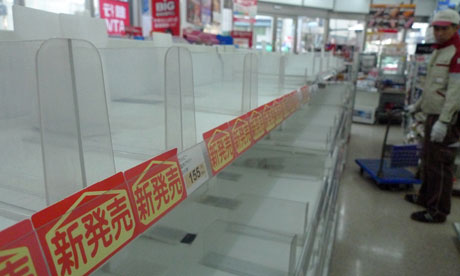
People in the capital, home to 12 million, snapped up radios, torches, candles, fuel containers and sleeping bags, while for the fourth day there was a run on bread, canned goods, instant noodles, bottled water and other foodstuffs at supermarkets.

Retailers said the panic buying was reminiscent of the oil crisis in the 1970s.

The electronics firm Panasonic said it was increasing production of batteries, which were being bought in large quantities as far away as Hiroshima in the south-west.

Fears are rising that if the hoarding frenzy continues it will affect the ability to deliver emergency supplies to the disaster zone. "The situation is hysterical," said Tomonao Matsuo, a spokesman for the instant noodle maker Nissin Foods. "People feel safer just by buying Cup Noodles."

Foreign journalists covering the nuclear crisis, including reporters from the BBC and CNN, withdrew from the Fukushima area. On Monday, the German magazine Der Spiegel said its veteran war correspondent was being pulled out of Tokyo.

Tourists cut short holidays and descended on international airports in Tokyo and Osaka, seeking flights home. They included about 200 South Koreans who have now arrived back in Seoul.

Liezel Strauss, a South African, said on Twitter on Tuesday morning: "I just woke up to several calls & emails, family & husband freaking out, it's time to go, flight booked to singapore this pm."

She added: "Realised no use staying stressing + freaking my family out if i'm not helping and physically contributing, I want to but reality is I'm not."

The number of people stranded at Narita airport, near Tokyo, rose after airlines cancelled flights but officials said there had been no surge in passenger numbers.

Air China cancelled flights to Tokyo from Beijing and Shanghai. Other airlines in the region said they were monitoring the situation but had no immediate plans to cancel services.

South Korea has urged its nationals in Japan to stay away from the quake zone while Germany advised its citizens to consider leaving the country.

The French embassy warned that a radioactive wind could reach Tokyo on Tuesday evening and advised its citizens to leave.

Britain's Foreign Office advised against all non-essential travel to Tokyo and north-eastern Japan. "Our advice is people should take their lead from the Japanese authorities," the Foreign Office minister Jeremy Browne told Sky News.

The US state department urged its citizens to avoid tourism and non-essential travel to Japan. "[Our] travel advice is not to go to that part of Japan in any case unless you have an extremely compelling reason for doing so," it said.

Japan's government has ordered people within 12 miles of the Fukushima No 1 plant, about 150 miles north-east of Tokyo, to evacuate. Those living between 12 and 19 miles from the plant were told to stay indoors due to fears of exposure to radiation.

In Saitama, a prefecture north of Tokyo where safe but higher radiation levels have been detected, residents struggled to secure food. Yoshiyuki Sakuma was one of many who could not find a single bag of rice. "I couldn't find any anywhere," he said, adding he was now searching for bread.

"If you lose electricity, water and gas, at least you can still eat bread."

http://www.guardian.co.uk/world/2011/mar/15/japan-nuclear-emergency-panic-buying


Here is a neat website and is worth watching for a few weeks especailly for the few that live on the West Coast.

Welcome to RadiationNetwork.com, home of the National Radiation Map, depicting environmental radiation levels across the USA, updated in real time every minute. This is the first web site where the average citizen (or anyone in the world) can see what radiation levels are anywhere in the USA at any time


http://www.radiationnetwork.com/

Thursday, October 28, 2010

Thursday 10-28-10

More political Junk, another surprise voter fraud, unbelievable lol


Nevada voting machines automatically checking Harry Reid's name; voting machine technicians are SEIU membersBy: Mark Hemingway
Commentary Staff Writer
10/26/10 6:12 PM EDT
Clark County is where three quarters of Nevada's residents and live and where Senate Majority Leader Harry Reid's son Rory is a county commissioner. Rory is also a Democratic candidate for governor.

Since early voting started, there have been credible reports that voting machines in Clark County, Nevada are automatically checking Harry Reid's name on the ballot:

Voter Joyce Ferrara said when they went to vote for Republican Sharron Angle, her Democratic opponent, Sen. Harry Reid's name was already checked.

Ferrara said she wasn't alone in her voting experience. She said her husband and several others voting at the same time all had the same thing happen.

"Something's not right," Ferrara said. "One person that's a fluke. Two, that's strange. But several within a five minute period of time -- that's wrong."

Clark County Registrar of Voters Larry Lomax said there is no voter fraud, although the issues do come up because the touch-screens are sensitive. For that reason, a person may not want to have their fingers linger too long on the screen after they make a selection at any time.

Now there's absolutely no independently verified evidence of chicanery with the voting machines (yet), but it is worth noting that the voting machine technicians in Clark County are members of the Service Employees International Union. The SEIU spent $63 million in elections in 2008 and is planning on spending $44 million more this election cycle -- nearly all of that on Democrats. White House political director Patrick Gaspard is formerly the SEIU's top lobbyist, and former SEIU president Andy Stern was the most frequent visitor to the White House last year.

Just in Nevada, the SEIU has given a lot to groups that are heavily vested in the state -- in just one prominent example, the SEIU gave $500,000 to the Patriot Majority PAC, which has spent $1.3 million against Reid's opponent Sharron Angle. They've and have dropped large sums directly on candidates:

NV-3
Joe Heck (R)
Oppose
$140,000.00

NV-3
Dina Titus (D)
Support
$344,984.00

NV-Senate
Sharron E. Angle (R)
Oppose
$225,000.00


Now the county voting technicians aren't unique here -- many of Clark County's employees are also represented by the SEIU. But it is worth mentioning, the SEIU is hyperpoliticized and has seen its fair share of corruption. (It certainly seems more questionable than Diebold, the voting machine manufacturer with Republican ties that was at the center of many conspiracy theories on the left during the Bush administration.)

Unions increasingly have a major financial stake in election outcomes, both as a matter of their own election expenditures, and as a function of what they stand to gain if their legislative agenda is enacted. Should they really be responsible for tabulating the votes? That's certainly something voters ought to think long and hard about.

Below is Clark County's SEIU contract -- On Page 75, in Appendix A, voting machine technicians are listed as positions represented by SEIU.

http://www.washingtonexaminer.com/opinion/blogs/beltway-confidential/Voting-machines-in-Clark-County-Nevada-automatically-checking-Harry-Reids-name-Voting-machine-technicians-are-members-of-SEIU-105815608.html

Electromagnetic pulse impact far and wide One EMP burst and the world goes dark
The sky erupts. Cities darken, food spoils and homes fall silent. Civilization collapses.
End-of-the-world novel? A video game? Or could such a scenario loom in America's future?

There is talk of catastrophe ahead, depending on whom you believe, because of the threat of an electromagnetic pulse triggered by either a supersized solar storm or terrorist A-bomb, both capable of disabling the electric grid that powers modern life.

Electromagnetic pulses (EMP) are oversized outbursts of atmospheric electricity. Whether powered by geomagnetic storms or by nuclear blasts, their resultant intense magnetic fields can induce ground currents strong enough to burn out power lines and electrical equipment across state lines.

The threat has even become political fodder, drawing warnings from former House speaker Newt Gingrich, a likely presidential contender.

"We are not today hardened against this," he told a Heritage Foundation audience last year. "It is an enormous catastrophic threat."

Meanwhile, in Congress, a "Grid Act" bill aimed at the threat awaits Senate action, having passed in the House of Representatives.

Fear is evident. With the sun's 11-year solar cycle ramping up for its stormy maximum in 2012, and nuclear concerns swirling about Iran and North Korea, a drumbeat of reports and blue-ribbon panels center on electromagnetic pulse scenarios.

"We're taking this seriously," says Ed Legge of the Edison Electric Institute in Washington, which represents utilities. He points to a North American Electric Reliability Corp. (NERC) report in June, conducted with the Energy Department, that found pulse threats to the grid "may be much greater than anticipated."

There are "some important reasons for concern," says physicist Yousaf Butt of the Harvard-Smithsonian Center for Astrophysics in Cambridge, Mass. "But there is also a lot of fluff."

At risk are the more than 200,000 miles of high-voltage transmission lines that cross North America, supplying 1,800 utilities the power for TVs, lights, refrigerators and air conditioners in homes, and for the businesses, hospitals and police stations that take care of us all.

"The electric grid's vulnerability to cyber and to other attacks is one of the single greatest threats to our national security," Rep. Ed Markey, D-Mass., said in June as he introduced the bill to the House of Representatives.

Markey and others point to the August 2003 blackout that struck states from Michigan to Massachusetts, and southeastern Canada, as a sign of the grid's vulnerability. Triggered by high-voltage lines stretched by heat until they sagged onto overgrown tree branches, the two-day blackout shut down 100 power plants, cut juice to about 55 million people and cost $6 billion, says the 2004 U.S.-Canada Power System Outage Task Force.

Despite the costs, most of them from lost work, a National Center for Environmental Health report in 2005 found "minimal" death or injuries tied directly to the 2003 blackout — a few people died in carbon monoxide poisonings as a result of generators running in their homes or from fires started from candles. But the effects were pervasive: Television and radio stations went off the air in Detroit, traffic lights and train lines stopped running in New York, turning Manhattan into the world's largest pedestrian mall, and water had to be boiled after water mains lost pressure in Cleveland.

Simple physics, big worry

The electromagnetic pulse threat is a function of simple physics: Electromagnetic pulses and geomagnetic storms can alter Earth's magnetic field. Changing magnetic fields in the atmosphere, in turn, can trigger surging currents in power lines.

"It is a well-understood phenomenon," says Butt, who this year reviewed geomagnetic and nuke blast worries in The Space Review.

Two historic incidents often figure in the discussion:

• On July 9, 1962, the Atomic Energy Commission and the Defense Atomic Support Agency detonated the Starfish Prime, a 1.4-megaton H-bomb test at an altitude of 250 miles, some 900 miles southwest of Hawaii over the Pacific Ocean. The pulse shorted out streetlights in Oahu.

• On March 9, 1989, the sun spat a million-mile-wide blast of high-temperature charged solar gas straight at the Earth. The "coronal mass ejection" struck the planet three days later, triggering a geomagnetic storm that made the northern lights visible in Texas. The storm also induced currents in Quebec's power grid that knocked out power for 6 million people in Canada and the USA for at least nine hours.

"A lot of the questions are what steps does it make sense to take," Legge says. "We could effectively gold-plate every component in the system, but the cost would mean that people can't afford the rates that would result to pay for it."

"The high-altitude nuclear-weapon-generated electromagnetic pulse is one of a small number of threats that has the potential to hold our society seriously at risk," concluded a 2008 EMP Commission report headed by William Graham, a former science adviser to President Reagan.

The terror effect

In the nuclear scenario, the detonation of an atomic bomb anywhere from 25 to 500 miles high electrifies, or ionizes, the atmosphere about 25 miles up, triggering a series of electromagnetic pulses. The pulse's reach varies with the size of the bomb, the height of its blast and design.

Gingrich last year cited the EMP Commission report in warning, "One weapon of this kind that went off over Omaha would eliminate most of the electrical production in the United States."

But some take issue with that.

"You would really need something the size of a Soviet H-bomb to have effects that cross many states," Butt says. The massive Starfish Prime blast, he notes, was at least 70 times more powerful than the atomic bomb detonated over Hiroshima in 1945, and it may have blown out streetlights but it left the grid in Hawaii intact.

One complication for rogue nations or terrorists contemplating a high-altitude nuclear blast is that such an attack requires a missile to take the weapon at least 25 miles high to trigger the electromagnetic pulse. For nations, such a launch would invite massive nuclear retaliation from the USA's current stockpile of 5,000 warheads, many of them riding in submarines far from any pulse effects.

Any nation giving a terror group an atomic weapon and missile would face retaliation, Butt and others note, as nuclear forensics capabilities at the U.S. national labs would quickly trace the origins of the bomb, Butt says. "It would be suicide."

Super solar storm

On the solar front, the big fear is a solar super storm, a large, fast, coronal mass ejection with a magnetic field that lines up with an orientation perfectly opposite the Earth's own magnetic field, says solar physicist Bruce Tsurutani of NASA's Jet Propulsion Laboratory in Pasadena, Calif.

Tsuritani and other solar physicists view such an event as inevitable in the next 10 to 100 years.

"It has to be the perfect storm," Tsuratani says.

"We are almost guaranteed a very large solar storm at some point, but we are talking about a risk over decades," Butt says. Three power grids gird the continental U.S. — one crossing 39 Eastern states, one for 11 Western states and one for Texas.

Solutions?

In June, national security analyst Steven Aftergood of the Federation of American Scientists described congressional debate over power-grid security as "a somewhat jarring mix of prudent anticipation and extravagant doomsday warnings."

Although the physics underlying the geomagnetic and nuclear pulses are fundamentally the same, they have different solutions. A geomagnetic storm essentially produces a long-building surge dangerous to power lines and large transformers. A nuclear blast produces three waves of pulses.

Limiting the risk from the geomagnetic-storm-type threat involves stockpiling large transformers and installing dampers, essentially lightning rods, to dump surges into the ground from the grid. Even if such steps cost billions, the numbers come out looking reasonable compared with the $119 billion that a 2005 Electric Power Research Institute report estimated was the total nationwide cost of normal blackouts every year.

"EMP is one of a small number of threats that can hold our society at risk of catastrophic consequences," Graham testified to a congressional committee last year, endorsing such mitigation steps.

Stephen Younger, former head of the Defense Threat Reduction Agency, last year argued against the catastrophic scenarios in his book, The Bomb, suggesting the effects of a pulse would be more random, temporary and limited than Graham and others suggest.

The June NERC report essentially calls for more study of the problem, warning of excessive costs to harden too much equipment against the nuclear risk. "If there are nuclear bombs exploding, we have lots of really, really big problems besides the power grid," Legge says.

http://www.usatoday.com/tech/science/2010-10-26-emp_N.htm?loc=interstitialskip

Does this suprise anyone? It will be tied to the shooting of the Marine Corp recurting station, recently. It will not surprise me when it is tied back to a wantabee Muslim also. Just like the Beltway snipers.

FBI: Pentagon, museum shootings linked to same gun
WASHINGTON - Shots fired at both the Pentagon and Museum of the Marine Corps came from the same weapon, the FBI says.
The agency also is looking into whether another shooting Monday night at a Marine Corps recruiting station in a storefront off Lee Highway in Chantilly, Va. is related.

Marines who work there discovered the shooting Tuesday morning, the FBI said. Investigators are conducting ballistics tests to determine whether the recruiting station shooting is related to the previous incidents.

Investigators were at the station "trying to link anything they can to what has already been proven," FBI spokeswoman Lindsay Godwin said.

The station was unoccupied and under renovation. Like the other two shooting sites, it is near a major roadway.

No one was injured in each of the incidents. FBI officials say they will not be releasing the type of gun used or the caliber of the ammunition in the incidents "to preserve the integrity of investigative efforts."

Steven Calvery, director of the civilian Pentagon Force Protection Agency, has said the gun used in the Pentagon shooting likely was a high-velocity rifle.

Security at the Pentagon has not been elevated since news of the latest shooting. Though all three shootings have targeted offices with links to the military, Godwin said the FBI has not issued any specific advisories or warnings to recruiting stations or other military buildings.

Calvery initially described the Pentagon incident as "a random event." Tuesday, Pentagon protection agency spokesman Chris Layman said that initial description was preliminary, though officials still don't believe there is a specific threat against the Pentagon.

"We are still trying to pursue as many leads as possible," Layman said, adding that he did not have any details on the type of gun used.

Calvery told reporters that a number of his officers reported hearing five to seven shots fired at about 4:55 a.m. Oct. 19 near the south parking lot of the Pentagon, which faces I-395.

A search of the structure found fragments of two bullets still embedded in two windows on the third and fourth floors. The bullets had shattered but did not penetrate the windows, which were part of unoccupied offices that are being renovated.

Bullet holes also were discovered in windows at the museum, which is associated with the Quantico Marine Base about 30 miles south of the Pentagon.

A cleaning crew at the museum called police when they noticed the holes in a part of the building that faces Interstate 95.

A spokeswoman for the museum said it appeared to have been hit by at least 10 rounds -- five that struck glass and five marks on metal panels. Not all the bullets penetrated the glass, she said.

The museum did not receive any kind of threatening communication or messages before discovering the bullet scars. None of the museum's artifacts was hit.

In early March, a gunman opened fire at a Pentagon security checkpoint, wounding two police officers. John Patrick Bedell, 36, of Hollister, Calif., was shot by police and died hours later.

Anyone with information about the recent incidents can call Crime Solvers at (866) 411-8477 or text "TIP187" plus a message to CRIMES/274637.

http://wtop.com/?nid=25&sid=2094292

Pentagon: Equipment outage at Wyo. nuke site
WASHINGTON (AP) - An equipment failure disrupted communication between 50 nuclear missiles and the launch control center at Warren Air Force Base in Wyoming over the weekend, although the Air Force never lost the ability to launch the missiles.

Air Force spokesman Lt. Col. Todd Vician said the break occurred early Saturday and lasted less than one hour. The White House was briefed about the failure Tuesday morning.

There was no evidence of foul play, officials said Tuesday.

The Minuteman III intercontinental ballistic missiles are part of the 319th Missile Squadron stockpiled at Warren Air Force Base near Cheyenne, where 150 ICBMs are located. The failure affected 50 of them, or one-ninth of the U.S. arsenal. ICBMs at Air Force bases in Montana and North Dakota were not affected.

The equipment failure disrupted "communication between the control center and the missiles, but during that time they were still able to monitor the security of the affected missiles," Vician said. "The missiles were always protected. We have multiple redundancies and security features, and control features."

The launch control center computers communicate through an underground cable, but Vician could not confirm the cable was the source of the problem.

Vician said base personnel inspected all 50 missile sites and found no evidence of damage.

One military official, who spoke on condition of anonymity because he was not authorized to discuss the incident publicly, said the equipment in the launch control center has been the subject of unspecified communications problems in the past.

The White House referred questions to the Pentagon.

The failure was first reported by The Atlantic on the magazine's website.

The communications failure is the latest in a series of nuclear mishaps that have plagued the Air Force in recent years.

In August 2007, an Air Force B-52 bomber was mistakenly armed with six nuclear-tipped cruise missiles and flown from Minot Air Force Base, N.D., to Barksdale Air Force Base, La. At the time, the pilot and crew were unaware they had nuclear arms aboard.

Then, in March 2008, the Pentagon disclosed the mistaken shipment to Taiwan of four electrical fuses for ballistic missile warheads and launched a broad investigation into the military's handling of nuclear related materials.

An internal report asserted that slippage in the Air Force's nuclear standards was a problem that has been identified but not effectively addressed for more than a decade. Those findings led to Defense Secretary Robert Gates' decision to fire Air Force Secretary Michael Wynne and Gen. Michael Moseley, the Air Force chief of staff.

http://www.wtop.com/?nid=116&sid=2094898