Showing posts with label stupid stuff. Show all posts

Monday, July 25, 2016

Monday 07-25-16

As Biometric Scanning Use Grows, So Does Security Risk


Without you necessarily realizing it, your unique attributes — or "biometrics" — are being used to verify your identity.
Every time you unlock your smartphone, use a fingerprint scanner at the airport, or upload a photo with facial recognition to Facebook, your physical attributes are scanned and scrutinized against a template.
The use of biometrics has exploded in recent years, with companies ranging from 24-Hour Fitness to NYU Langone Medical Center using this convenient technology to identify their customers.
By 2019, biometrics are expected to be a 25-billion-dollar industry with more than 500 million biometric scanners in use around the world, according to Marc Goodman, an advisor to Interpol and the FBI. Newest to the scene, Wells Fargo this fall will begin offering a smartphone app with biometric authentication — making all your financial information just an eye scan away.
With biometrics, there's no need to memorize an unwieldy sequence of numbers and letters as with passwords — and consumers value that convenience. In a OnePoll/Gigya survey, 80 percent of consumers who expressed a preference said they think biometric authentication is more secure than traditional passwords, and 52 percent of consumers said they would choose anything but a traditional password when given the choice.
But, unlike a password, if a person's biometrics are hacked, they can't be changed.
Read More: 5.6 Million Fingerprints (Not 1.1 Million) Were Stolen in OPM Breach
"You can always get a new credit card. You can always create a new password. [It's] really hard to get new fingers. You only have ten of them and once that information leaks, it's out and there's nothing you can do," Goodman said in an interview with NBC News.
Most companies rolling out biometrics say they will safeguard consumer biometric data carefully to prevent against hacks. Wells Fargo, for example, will not store the original images of their customers' eyes used in authentication, and the data will be encrypted.
But there have already been cases of biometric hacking on a large scale. An estimated 22 million people had their personal data stolen in a massive data breach at the Office of Personnel Management in December 2014, including RAND privacy expert and mother of two Rebecca Balebako. She received a letter from OPM last year informing her that her personal information, including her ten fingerprints, were stolen in the breach.
 
Balebako worries that her information was stolen by a foreign state, like China, and that it could be used against her or her family. Read More: MasterCard Customers Will Soon Be Able to Use a 'Selfie' Password
"That information is going to remain stolen, and I'm not going to change my fingerprints. I also don't know what they're going to do with information about my children or about my husband or about his family," Balebako said.
Balebako had submitted years of personal information, including her Social Security number and previous addresses, for a government background check required for her job.
"I don't know what to do. I work in this field. I'm a security researcher. I'm a privacy researcher. And I don't know what to do. I can't see there's much I can do to protect myself," Balebako said.                      
As biometric technology grows more personal and more widespread, so too do the risks to personal privacy.
"The best thing that we can do is to demand more from our government and from the companies to whom we provide this information, to hold them accountable," Goodman said. "As our society moves more and more online and citizens spend more and more of their time in digital space, law enforcement has failed to keep up. And this major gap is growing larger and larger."

http://www.nbcnews.com/tech/tech-news/biometric-scanning-use-grows-so-do-security-risks-n593161

Thief Destroys Teen’s “Back The Blue” Lemonade Stand

A thief tried to stop a 14-year-old Denton girl from a fundraiser for the families of fallen police officers.
Mia Cagle wanted to have a lemonade stand after she heard about the deaths of the officers in Dallas and Baton Rogue.
“I asked my Mom, ‘can I please help them?’ I just really wanted to help them” she says.
So last weekend, she did – complete with “Back The Blue” signs and a gallon of Country Time Lemonade. But when she stepped away for a minute, somebody stole her bench, broke her table and destroyed her signs. They didn’t steal any money, but succeeded in taking some of her faith.
“I was just heartbroken, because these people who I’m helping needed that, and I was just in shock,” she says.
Her family called Denton Police, but they never expected the reaction they received from the property crime detectives.
“We thought, well, what can we do to show our appreciation for her support? So we decided to replace her lemonade stand,” says Detective Wade Laughlin with the Denton Police Department.
Using their own money, the detectives bought a new table, markers, posters boards, lemonade and cups. And Thursday – Mia’s 14th birthday – she was back in business.
“The police are here to help the community whichever way we can,” says Det. Laughlin.
“I’m like ‘thank you, somebody has our back’, ” Mia says.
A life lesson in turning lemons into lemonade – with a little help from the blue.
“The situation that we’re in is heartbreaking, but the good that comes and the people who jump out of the sidelines to help,” says customer Meg Langlitz. “It’s heartwarming.”
Mia has to date raised more than $700. Denton Police say they have an open investigation into the theft.

http://dfw.cbslocal.com/2016/07/21/thief-destroys-teens-back-the-blue-lemonade-stand/

Friday, July 1, 2016

Friday 07-01-16

Very sad, but what do you expect when you don't promote patriotism and becoming an American.  They always take action after the fact, but no one will lose their job, or be corrected.

State takes action after piles of flags found at vets cemetery

EXETER, R.I. (WPRI) — “It just broke my heart because everyone in this cemetery fought under that banner and every fiber of that flag is their blood, sweat, and tears.”
Stan Sniezyk visits his father’s grave every week at the Rhode Island Veterans Cemetery, and that was his reaction when he saw piles of torn and tattered American flags at the cemetery in Exeter last weekend.
The photos Sniezyk submitted to Call 12 for Action showed two piles of flags: one by a dumpster and the other by an open storage shed.
His photos were shared thousands of times on social media within a couple of days and sparked fury, especially among veterans and their families.
“I’ve been getting messages from California, Texas, Connecticut, Florida,” he said. “People are absolutely outraged at what they’ve done, how they’ve disgraced the American flag in a veterans cemetery of all places.”
Kasim Yarn, the state’s new director of Veterans Affairs, was one of the people who saw the photos online and said he went right to the cemetery.
“I was speechless when I saw,” he recalled. “Flags were not stowed properly and prepared for proper disposal. Flags were in bags, on the ground. The place was a mess, totally. Procedures weren’t being followed.”

Yarn said he’s implementing updated policies to make sure flags are properly folded and stored, as well as starting a new inspection process at the cemetery.
“At very minimum, I will go there weekly and walk around,” he said. “I will open up all those doors, every facility, to ensure things are being placed in a proper manner.”
The flags seen in the photos were properly burned after the cemetery got a permit from the Exeter Fire Department.

http://wpri.com/2016/06/29/va-director-takes-action-after-seeing-piles-of-flags-at-vets-cemetery/


School Calls Cops, Cops Call Child Services on Boy Who Made Harmless 'Brownies' Remark

Political correctness in the classroom leads to insane disciplinary policies.

 
BrowniesGunold Brunbauer / DreamstimeThis might be the most absurd case of a school
This might be the most absurd case of a school mishandling a disciplinary issue yet: an elementary school in Collingswood, New Jersey, called the police because a nine-year-old male student allegedly made a racist remark. As a result, the state's child services division has opened a wholly unnecessary investigation into the boy's parents.
It isn't cleared what he actually said—the school, William P. Tatem Elementary, has not returned my request for comment. But a local news story suggests that he did not use the word "brownies" to refer to persons of color. He was actually referring to the chocolate baked good, according to his parents. Given that he made the statement during a class party—it was the last day of school—this explanation makes sense. (His last name sounds Hispanic, if that matters.)
In either case, the school had absolutely no reason to involve the police. Administrators should be perfectly capable of dealing with this sort of thing on their own. His teacher, or principal, could have asked the boy and his accuser about the incident and rendered some verdict. They could have punished him, if punishment was called for.
Instead, a young boy was interrogated by an officer about a harmless comment he made while in school.
It's just never necessary to involve the police in perfectly routine, non-violent, non-criminal disputes between children. The school's decision to do so is indefensible.
But according to Philly.com, these kinds of automatic appeals to police authority are common:
The incident, which has sparked outrage among some parents, was one of several in the last month when Collingswood police have been called to look into school incidents that parents think hardly merit criminal investigation.
Superintendent Scott Oswald estimated that on some occasions over the last month, officers may have been called to as many as five incidents per day in the district of 1,875 students.
This has created concern among parents in the 14,000-resident borough, who have phoned their elected officials, met with Mayor James Maley, blasted social-media message boards, and even launched a petition calling on the Camden County Prosecutor's Office to "stop mandated criminal investigation of elementary school students."
It gets worse. Philly.com is also reporting that "the incident had been referred to the New Jersey Division of Child Protection and Permanency." I will be following up with this agency, the police, and the school.
The school turned a non-issue into a police issues, and the cops turned a police issue into a child services issue. All because school officials think it's a police officer's job to tell students to behave themselves, rather than the students' teachers. Truly, it's incidents like these that confirm the suspicions of many Americans (and many Donald Trump supporters) that their country is too politically correct.
 

Thursday, June 30, 2016

Thursday 06-30-16


FEMA Contractor: Unrest After 395% Food Price Spike Coming Soon

Preparations by various cogs of the national security complex, including FEMA, indicate a coming worldwide food shortage — and a resulting crisis marked by extreme civil unrest around the globe.
As Motherboard noted of two reports published previously by CNA Corporation, but which largely escaped attention, the world’s food supply could be insufficient to maintain even current populations much further into the future. And the crisis — which several factors indicate may already be underway — may begin to worsen considerably as early as 2020.
Employing a desktop game simulation of the conditions of a global food shortage, titled “Food Chain Reaction,” CNA’s Institute for Public Research brought together “65 officials from the US, Europe, Africa, India, Brazil, and key multilateral and intergovernmental institutions,” Motherboard explained. And the Institute, which oversaw the simulation, “primarily provides scientific research services for the Department of Homeland Security and the Federal Emergency Management Agency [FEMA].”
According to the website for Food Chain Reaction: A Global Food Security Game — no commentary on Orwellian overtones needed — the “simulation and exercise intended to improve understanding of how governments, institutions, and private sector interests might interact to address a crisis in the global food system,” and took place in early November 2015.
“The scenario,” the description continues, “is set five years from today in a world where population growth, rapid urbanization, extreme weather and political crises combine to threaten global food security. The game’s players — high-level decision makers representing nations, international institutions, and the private sector — will collaborate, negotiate, make decisions, and confront tradeoffs while dealing with a chain reaction of consequences resulting from their actions.”
Participants received the briefing for the game through a mock TV newscast, which “challenged players to imagine a global food system under stress due to extreme weather and other environmental factors, urbanization and other demographic pressures, rising global food prices, and falling food stock levels.”
After receiving information specific to each participant’s national and regional geography and climate, players were also permitted to employ solutions to the game’s burgeoning food crisis scenario on “national, bilateral, and/or broadly cooperative” levels.
Divided into four rounds, the simulation found spikes in food prices up to a whopping 395 percent, driven by extended crop failures in key regions, resultant from the confused reactions by international officials, drastic changes in the environment, and skyrocketing oil prices — many similar factors, the report notes, that drove a global food crisis spanning 2007 to 2008.
Though, at the height of the simulation’s worst repercussions, the food crisis affected virtually every societal and governmental aspect — such as mass civil unrest and widespread crop failures in the planet’s ‘breadbasket’ regions — the Institute ultimately painted a rosy picture of economic and agricultural recovery.
But for as detailed and reactive as the scope of the game sought to be, several glaring omissions likely skewed both results and proposed solutions — and despite backing from the U.S. government, the simulation’s corporate participants could have tacitly or overtly influenced the outcome.
Commissioned in part by Cargill, an industrial agribusiness behemoth, and Mars, the giant whose candy business has vested interests in promoting both genetically-modified food and industrial agriculture, the Food Chain Reaction simulation excluded among possible solutions the abolishment of industrial, factory farming. Considering large-scale agribusiness’ sizable impact on the environment, as well as the paradoxical systemwhereby industrial agriculture largely supports livestock from factory farms, that exclusion certainly calls into question any results.
Additionally, with FEMA an aspect of the futuristic simulation, it wouldn’t be outside the realm of possibility to see a call for increased funding in the name of ‘being prepared’ for a coming crisis of epic proportions.
Perhaps, though, an imperative exists in examining both the aspects of massive food shortage studied as well as potential solutions omitted. China recently began the push away from a meat-centric diet, in part because pollution from factory farms has wrought havoc in the air and water. All moralistic pontificating aside, a return to small-scale, organic farming and switching to vegetarian diets, or at least a reduction in consumption of meat, could avert or abate the coming crisis.

http://www.thedailysheeple.com/fema-contractor-unrest-after-395-food-price-spike-coming-soon_062016

Simple skin cancer check that few people do
Dermatologists recommend coming in annually for a once-over to check for skin cancer. It's quick, painless and can pick up on early signs of trouble when the disease is most treatable.
http://wtop.com/health/2016/06/simple-cancer-check-us/slide/1/

Be careful of what you read and trust

‘HIT MAN’ Homemade Silencers (And Other Internet Hilarity)

I think i might have stumbled upon an internet equivalent of a comedy jackpot. In a HubPages post by ‘fr0gman’, the excerpts of a supposedly banned book HIT MAN: A Technical Manual For Independent Contractors detail how to build a “homemade silencer”. While the plans are funny in themselves, the user comments after the article had me rolling.
 

HIT MAN: A Technical Manual For Independent Contractors
In this article I am going to discuss the methods described in this book to build an improvised silencer for a standard, fixed-barrel .22 caliber pistol. This technique is very inexpensive (you can build a working model for around $40.00). The techniques are very effective and it is worth noting that production and possession of an assembled silencer or the parts used to make a silencer are illegal in the United States and many other countries. This information is presented for information purposes ONLY and you are strongly encourage NOT to attempt to build a silencer unless you have the proper authorization from the government.
 

THE FINISHED PRODUCT
Your finished product is whisper-quiet, the way a silencer is supposed to be! It is inexpensive, effective and reusable for over four hundred rounds before you will need to repack.

As promised, here are some comments about the ‘Hit Man’ suppressor that made me laugh out loud:

 Brandon Laden 8 years ago
man i think this stuff is bad you have won a lot of respect from me i hope this works but thanks becouse no other page i have read tells actualy how to make the silencer only how ellegal it is to make so thanks!!!!!!!


Hold Me Beer 7 years ago
well put frogman, this is very interesting information but do suppose it could work with say a 9mm, 40 cal, or 45


viper777 7 years ago
Hi man,
thanks for your suggestions. Really helpful and they work with bullets. I m trying hard to do something similar to a shot gun (not bullets) gauge 12. My results are close to rubbish.
Anyone has any ideas or help ?


2 loud .17 HMR 7 years ago
any chance you could tell me where to get one from overseas?


jigga 6 years ago
im too lazy to create this, i really need one… so does n e one know how to make one outta a 20 oz popbottle tape and insulation, and does it work.


bigcliffcole 6 years ago
i’ve made one from a soda can and a couple of old hats before but it is olny good for a few shots or so but it was still fun to make and shoot.


Numbah9 6 years ago
Change to a higher impulse powder with a smaller charge such that the end of barrel pressure is near, or closer to, zero. Longer barrel helps. Requires some experimentation but does work rather well. 17cal Finnish sniper rifle adapts well to this technique


Redneck 6 years ago
I just tried the pop bottle, I wrapped hi voltage tape around bull barrel 10/22 ruger slid on mountain dew bottle with 1/2 inch hole in bottom center, walked outside and racked off 6 shots and did not even wake the old lady and did not hurt anything, hell I left it on there for now. I would say it cut down the sound by at least 2/3. I think tomorrow I will cut bottle in half and glue some steel wool all along insides leaving good passage for the bullet. This should help some more hell Im not trying to kill anybody, But if I want to snipe a deer in the night nobody will know, and it did not show in my scope, I bet frogmans works great , It took about 5 minutes to make this one.


yadaddy 6 years ago
ur retarded . . . go buy a keyless drill chuck that has a max larger than your o.d. of the barrel . . . better yet anneal the end of the barrel and use a tap and dye set . . . better yet if you didn’t know this already study a bit on proper machining. a dependabl supressor requires baffeling come on now just promise me you wont ruin your pistols or rifles by applying f*ckin fiberglass wtf ? and i really don’t care if i mis-spelled a few words


samalamadingdong 6 years ago
i made one using a similar idea ive made about 15 of these ive never had one blow up in my face


Ray Murphy 6 years ago
Why would any gun enthusiast want a silencer any way .. The big BANG is half the fun


what’s it matter 6 years ago
several people that i know made these things and they work really well, all u hear is the pin hitting sounds like a missfire.and about it being legal,…who gives a f*ck? i bet these people never speed eather huh?and if someone WAS goin to kill someone im sure they don’t want to buy one, that would be real smart.i cant even remember the guys name that wrote this (thanks by the way) because ive been reading everyones bullsh*t.. if you just left a comment just to talk shit talk sh*t to yourself and get a life.
and yo teach… i could 2 shits less if i mizspelledd anything.
yours truly
……. outlaw M.C.


shoot em up 6 years ago
Appreciate the info…my neighbor a couple of houses from me makes them. I know a lot about making them, but this adds to it.


Janie Hersch 6 years ago
My villain (in the book All’s Fair) is to be shot at Goodwood races (UK) I had no idea of the mechanics required by a Hit Man except speed, efficiency and secrecy. I am researching this now and am extremely grateful for the information on here. I thought a seach for Hit Man would bring a zero; this is welcome information, many thanks.

 http://www.thefirearmblog.com/blog/2016/06/27/hit-man-homemade-silencers-and-other-internet-hilarity/

Friday, May 6, 2016

Friday 05-06-16

FBI Wants to Exempt Its Massive Biometric Database from Some Federal Privacy Rules

The FBI wants to block individuals from knowing if their information is in a massive repository of biometric records, which includes fingerprints and facial scans, if the release of information would "compromise" a law enforcement investigation.
The FBI’s biometric database, known as the “Next Generation Identification System,” gathers a wide scope of information, including palm prints, fingerprints, iris scans, facial and tattoo photographs, and biographies for millions of people.  
On Thursday, the Justice Department Agency plans to propose that the database be exempt from several provisions of  the Privacy Act -- legislation that requires federal agencies to share information about the records they collect with the individual subject of those records, allowing them to verify and correct them if needed.
Aside from criminals, suspects, and detainees, the system includes data from people fingerprinted for jobs, licenses, military or volunteer service, background checks, security clearances, and naturalization, among other government processes.
Letting individuals view their own records, or even the accounting of those records, could compromise criminal investigations or "national security efforts," potentially revealing a “sensitive investigative technique” or information that could help a subject “avoid detection or apprehension,” the draft posting said.
Another clause requires agencies to keep the records they collect to assure individuals that any determination made about them was made fairly. Arguing for an exemption, the FBI posting claimed that it is “impossible to know in advance what information is accurate, relevant, timely and complete” for “authorized law enforcement purposes.”
“With time, seemingly irrelevant or untimely information may acquire new significance when new details are brought to light," the posting said. Information contained in the database could help with “establishing patterns of activity and providing criminal lead.”
The proposal, open for public comment for a month after it’s officially posted, would set a worrying precedent in which law enforcement has significant leeway to decide what information to collect without informing the subject, according to Jeramie Scott, a National Security Counsel at the Electronic Privacy Information Center, a research group advocating for digital civil liberties.
In 2014, EPIC won a lawsuit against the FBI arguing that the contracts and technical requirements supporting the Next Generation Identification database be published.
The proposal’s suggestion that data could be used to establish “patterns of activity” was particularly troubling, Scott said.
“We don’t know exactly what that means,” Scott told Nextgov in an interview. “If you have no ability to access the record the FBI has on you, even when you’re not part of an investigation or under investigation, and lo and behold inaccurate information forms a ‘pattern of activity’ that then subjects you to [be] the focus of the FBI, then that’s a problem.”
It’s unclear how many individuals are covered in the database.  FBI documents obtained by privacy rights group the Electronic Frontier Foundation in 2014 suggested that the FBI’s facial recognition component was on track to contain 52 million images by 2015.
FBI did not respond to Nextgov’s request for comment.

http://www.nextgov.com/emerging-tech/2016/05/fbi-wants-exempt-its-massive-biometric-database-federal-privacy-rules/128051/

Court Scolds Maryland Cops for Stingray Use, Issues Landmark Decision on Surveillance

In what civil liberties and privacy advocates are calling a landmark decision, Maryland’s second-highest court has handed down the first appellate opinion in the country affirming that police must obtain a probable cause warrant to track cell phones.
The Maryland Court of Special Appeals issued the opinion in a ruling that rebuked Baltimore Police for failing to disclose that they had used a device called a cell site simulator, often referred to as a “stingray,” to locate an attempted murder suspect, The Baltimore Sun reports.
In court testimony last April, a Baltimore detective revealed that the Baltimore Police Department had used Stingrays more than 4,300 times since 2007, repeatedly failing to notify courts of their use in criminal cases.
The court rejected the state of Maryland’s argument that anyone turning on a phone was “voluntarily” sharing their whereabouts with the police. And the 73-page opinion also harshly scolded Baltimore police for trying to conceal their use of Stingrays from the court.
The panel of judges wrote:
We conclude that people have a reasonable expectation that their cell phones will not be used as real-time tracking devices by law enforcement, and — recognizing that the Fourth Amendment protects people and not simply areas — that people have an objectively reasonable expectation of privacy in real-time cell phone location information.

Stingrays are surveillance devices that act as a fake cell phone tower. They essentially allow the government to electronically search large areas for a particular cell phone’s signal – gathering data on potentially thousands of innocent people along the way.
 
As if this isn’t invasive enough, police have attempted to use them while avoiding many of the traditional limitations set forth in the Constitution, like individualized warrants.
Experts say that the impact of the appellate court’s ruling will be far-reaching, since it is the first court of its kind in the country to rule on whether police must disclose their intent to a judge obtain a warrant to use devices like Stingrays.
Dan Kobrin, an attorney with the public defender’s office who argued the case before the court, said the impact is “enormous” and “will hopefully curb abuse of this device and bring it out into the sunlight.”
Nathan Freed Wessler, a staff attorney who specializes in technology and privacy with the American Civil Liberties Union, said of the decision:
The court’s opinion is a resounding defense of Fourth Amendment rights in the digital age. The court’s withering rebuke of secret and warrantless use of invasive cell phone tracking technology shows why it is so important for these kinds of privacy invasions to be subjected to judicial review.
Other courts will be able to look to this opinion as they address rampant use of cell site simulators by police departments across the country.

In 2014, awareness of the use of stingray technology grew when defense attorneys in Baltimore began to suspect and challenge the use of the device. In one case, a detective took the stand and refused to discuss the technology, and was nearly held in contempt by a judge.
Last April, The Baltimore Sun published a non-disclosure agreement that the Baltimore Police Department signed in 2011 with the FBI and Harris Corporation, a leading manufacturer of Stingrays, in which local authorities agreed never to disclose use of a stingray device.

How to Disappear Off the Grid Completely (Ad)

The agreement required the department to conceal its use of Stingrays “during pre-trial matters, in search warrants and related affidavits, in discovery, in response to court ordered disclosure … or in testimony in any phase of civil or criminal trial, without the prior written approval of the FBI.”
Police departments across the country have been signing similar agreements, and prosecutors have even dropped criminal cases to avoid facing questions about Stingrays, The Intercept reports.
In 2014, Harris Corporation went so far as to petition the Federal Communications Commission to block a FOIA request for user manuals for some of the company’s products.
While the Maryland court’s decision is a positive one that is a step in the right direction, Stingray devices are hardly the only surveillance method cops use to track us. In December, The Intercept published The Secret Surveillance Catalogue, a “secret, internal U.S. government catalogue of dozens of cellphone surveillance devices used by the military and by intelligence agencies. The document, thick with previously undisclosed information, also offers rare insight into the spying capabilities of federal law enforcement and local police inside the United States.”
Police departments also use another form of surveillance technology that hasn’t received much publicity – yet: automatic license plate readers. (I didn’t know this existed until I was pulled over by a Maryland state trooper for driving on a “suspended registration.” My offense? Failing to get a car emissions test. I’d moved to the state a year prior and had no idea I even needed such a thing.)
Automatic license plate readers are mounted on police cars or on objects like road signs and bridges. They use small high-speed cameras to photograph thousands of plates per minute.
The information captured by the readers – including the license plate number, and the date, time, and location of every scan – is collected and sometimes pooled into regional sharing systems. As a result, enormous databases of innocent motorists’ location information are growing rapidly. This information is often retained for years or even indefinitely, with few or no restrictions to protect privacy rights.
Law enforcement agencies claim that surveillance devices help them keep us safe, but the ACLU says the gadgets are more commonly used to solve simple crimes.
They also claim that the devices are intended to prevent terrorist attacks (in fact, many departments have bought them under the guise of that purpose), but to date, there hasn’t been a single documented instance of that actually happening.
No, the goal is control. It always has been, and it always will be.

http://www.activistpost.com/2016/04/court-issues-landmark-decision-on-stingray-surveillance.html

Maybe instead of listing this stupid stuff, I should have listed it a childish naive stuff.

DOJ halts use of word ‘felon’ and ‘convict’ to describe inmates

image: http://www.trunews.com/wp-content/uploads/2013/09/prison-bars-jail_s640x274.jpg
prison-bars-jail_s640x274
An official with the Department of Justice said the agency will no longer call people “felons” or “convicts” after they are released from prison because it is too hard on them emotionally.
Assistant Attorney General Karol Mason wrote a piece in The Washington Post Wednesday saying “many of the formerly incarcerated men, women, and young people I talk with say that no punishment is harsher than being permanently branded a ‘felon’ or ‘offender.’”
Mason said the decision is not to condone their behavior, but to use words to help them reenter society.
image: http://www.trunews.com/wp-content/uploads/2014/08/Usdepartmentofjustice-300x199.jpg
Usdepartmentofjustice
In my role as head of the division of the Justice Department that funds and supports hundreds of reentry programs throughout the country, I have come to believe that we have a responsibility to reduce not only the physical but also the psychological barriers to reintegration.  The labels we affix to those who have served time can drain their sense of self-worth and perpetuate a cycle of crime, the very thing reentry programs are designed to prevent.  In an effort to solidify the principles of individual redemption and second chances that our society stands for, I recently issued an agency-wide policy directing our employees to consider how the language we use affects reentry success.
This new policy statement replaces unnecessarily disparaging labels with terms like “person who committed a crime” and “individual who was incarcerated,” decoupling past actions from the person being described and anticipating the contributions we expect them to make when they return.  We will be using the new terminology in speeches, solicitations, website content, and social media posts, and I am hopeful that other agencies and organizations will consider doing the same.
This is one of many steps the Obama administration is using to help recently released offenders. President Barack Obama announced in 2015 federal agencies would no longer ask if people were felons in the early job application steps.

http://www.trunews.com/doj-halts-use-of-word-felon-and-convict-to-describe-inmates/#jVpQhQt4GGJ8ydxC.99

Monday, April 25, 2016

Monday 04-25-16

Does this really surprise anyone at all.

Report: Children of refugees get more federal benefits than poor U.S. kids

America loves kids, but Uncle Sam has a favorite: children of refugees.

Among recipients of food stamps, welfare cash and Social Security payments, refugee children receive more in taxpayer-funded aid than children of citizens, according to a new report on federal spending from the pro-immigration Migration Policy Institute.

For example, 30 percent of refugee children live in households that received food stamps from 2009-13. Among American children, the number was 27 percent, said the report titled, "Young Children of Refugees in the United States: Integration Successes and Challenges."

Some 8 percent received cash welfare, compared with 6 percent of U.S. citizen households. And 5 percent of children of refugees were part of Social Security's Supplemental Security Income program, compared with 4 percent of U.S. children.

The reason? The report said that aid is typically higher to refugees because they arrive poor, a situation likely to hit hard when an estimated 20,000 Syrian refugees arrive in the U.S. before the end of the year.
 
http://www.washingtonexaminer.com/feds-shower-benefits-cash-on-refugee-children-more-than-for-u.s.-kids/article/2589398

Just a taste of things to come, can McDonalds still sell the same hamburger for the same price in one city that has a 10 dollar minimum wage and in another city where it is 15 an hour.  Should they charge more in one city then the other or just spread the loss around to everyone equally?

UC Berkeley Touts $15 Minimum Wage Law, Then Fires Hundreds Of Workers After It Passes


labor Markets: Hundreds of employees at the University of California at Berkeley are getting schooled in basic economics, as the $15 minimum wage just cost them their jobs. Too bad liberal elites “fighting for $15” don’t get it.
A week after California Gov. Jerry Brown signed the state’s $15 minimum wage boost into law, UC Berkeley Chancellor Nicholas Dirks sent a memo to employees announcing that 500 jobs were getting cut.
Coincidence? Not really.
Last year, University of California President Janet Napolitano announced plans to boost its minimum wage to $15 at the start of next school year, independent of the state law. Since UC Berkeley was already in financial trouble — it ran a $109 million deficit last year and is projecting a deficit of $150 million this year — number crunchers there had to have factored in the higher mandated wage when making their layoff decisions.
Those workers might want to have a chat with the folks at UC Berkeley’s Center for Labor Research, who just days before Brown signed the wage-hike bill released a study touting the minimum wage as a boon to low-income household breadwinners.
After that report came out, Ken Jacobs, chairman of the UC Berkeley center, told the Los Angeles Times, “This is a very big deal for low-wage workers in California, for their families and for their children.”
It is a big deal, as well, to those soon to be out of work UC Berkeley workers.
But why is anyone surprised about jobs cuts following a wage hike? It’s one of the most basic laws of economics. Any high school kid taking Econ 101 can explain it:  If you raise the price of something, demand goes down.
Keep in mind, too, that a $15 minimum wage is more than twice the federal minimum wage today. And it would set the wage floor higher than it’s ever been. On an inflation-adjusted basis, the minimum wage peaked in 1968 at just over $10 an hour.
Even the liberal Mother Jones admits that a $15 minimum is “terra incognita” and “might not be entirely benign.”
What’s surprising, then, is that unions, liberals and others pushing the minimum wage hike have managed to convince the public that this law somehow doesn’t apply to the labor market, and so succeeded in getting $15 laws in California, New York and Seattle. You can bet that either Bernie Sanders or Hillary Clinton will push $15 at the national level if either is elected.
Berkeley employees whose jobs are on the chopping block might want to educate these leaders about the perils of this idea.

http://www.investors.com/politics/editorials/uc-berkeley-touts-15-minimum-wage-then-fires-hundreds-of-workers-after-it-passes/

Monday, April 11, 2016

Monday 04-11-16

Drought ravages Thai sugar cane crop
A global sugar shortage is looming and prices are soaring. The world's top sugar cane exporters, India and Thailand, are being ravaged by a severe drought brought on by the El Nino weather phenomenon. Thailand - the world second-largest sugar cane exporter - is going to be shipping 20 to 30 percent less of the sweetener compared to last year. And the situation may even get worse next year.


Bob Bass of TCI tells press and citizens to turn cameras off: Shows them video already on YouTube

As a shining example of trashing openness and transparency in government, Bob “the Bully” Bass, County Corrections Partnership Coordinator and Detention Facilities Specialist with the Tennessee Corrections Institute (TCI) told the press and citizens present at an open public meeting to turn their cameras off.  His reason?  The presentation contained law enforcement sensitive information.

That might have had some validity had Bob “the Bully” Bass not said later in the meeting that the video he showed was available on YouTube.  Yeap, that’s right.  You can watch the video online on YouTube.
Now back to that open meeting thing.  It’s an OPEN MEETING BOB.  You know, the kind where the public is invited to attend so that they can see what their government is up to.  Oh that’s right, you and the machine don’t want the people watching you.
Even the press didn’t show up to the last Blount County Corrections Partnership (BCCP) meeting.  The paper watched the recording available online and reported on it two days after the meeting.  What’s the press going to do when they don’t show up and the meetings haven’t been recorded?
The investigative journalist providing the video told me that the meetings of the County Corrections Partnership, in the county where this video was recorded, are held in a restricted area.  Yeah, that’s right.  The meetings open to the public are held in a restricted area.  Just exactly how many people are going to make an effort to get through security and into a restricted area to attend an “open” public meeting?
That reminds of the meeting here in Blount County last June when Bob “the Bully” Bass gave the same presentation to the Blount County Corrections Partnership.  That meeting was held at the Justice Center not the courthouse.  The IT Director had made arrangements to record that meeting but Bob “the Bully” Bass stopped that recording as well.
The rule makers want it this way.  The meetings are “open” to the public but they don’t have to be convenient or recorded.  Out of sight, out of mind.
Except that it is your wallets they are emptying.  Remember the jail study which said that Blount County needed to totally rethink the use of its jail?  Remember the $1 million plan with a plan for another million?  Now Bob “the Bully” Bass is pushing to build after his off the video camera presentation.  A member of the TCI Board of Control said that Blount County could use a nice 100,000 person jail.
Do you want Blount County to be the location of the next Brushy Mountain prison?  If not, show up Thursday at 5:30 in room 315, where there isn’t a video camera rolling and the machine hopes you aren’t present and watching them.

http://www.bcpublicrecord.com/?p=8458

Wednesday, March 9, 2016

Wednesday 03-09-16

I'm not there yet, but soon will be if the lairs keep lying, and basically the people that defend it need to be honest about it.  I might have a small amount of respect for Al Sharpton if he would have denounced Twana Brawley after she admitted she lied.  Maybe not, but maybe.

I NOW BASICALLY ASSUME THAT ANY JUICY RACISM STORY IS FAKE, AND I’M SELDOM WRONG: More damaging evidence in the SUNY Albany racial hoax:

Audio from two 911 phone calls and video footage of the alleged racially motivated assault at a New York college has been released, providing more evidence why the women who made the accusation are now being charged with false reporting.
The three women claimed they were attacked by more than a dozen white people who hurled racial slurs at them as they rode a bus back to the State University of New York at Albany campus. But video footage from the bus and cell phone cameras showed that one of the alleged victims threw the first punch and that one of the accusers is the one who used a racial slur — against a white passenger.
Now some of that footage has been released, but it is difficult to tell what exactly happened. The 911 audio is more damaging, showing one of the accusers saying “I think it’s so funny” and “I beat up a boy” before the call connected to a dispatcher.
When the call connected, the accuser then tells the story that she was “jumped” on a bus and that it was a racially motivated attack. . . .
The incident, which occurred in late January, sparked protests at the campus and a fountain of support for the accusers. Even now that evidence has come to light showing they were not the victims of a hate crime, there are some in the community standing by them.
The Upstate New York Black Lives Matter Organization has issued a letter supporting the women, calling the evidence against them “inconclusive.”

http://pjmedia.com/instapundit/227968/

FBI Anti-Terrorism Website Up with Muslim Group Changes, Omission of Islamist Extremists

A government anti-radicalization internet program set to be launched months ago is finally up and running with the changes demanded by Islamic activists that claimed the original version was biased against Muslims.
This is a story Judicial Watch has followed closely. Back in November JW reported that the Obama administration abruptly pulled the plug on a new Federal Bureau of Investigation (FBI) website aimed at preventing the radicalization of youth after Muslim and Arab rights groups protested that it was discriminatory and would lead to bullying, bias and religious profiling of students. The interactive website (“Don’t Be a Puppet”) was created by the U.S. government as a tool for the nation’s schools to prevent susceptible youth from getting recruited online by terrorists. The stated goal is to combat a growing epidemic of violent extremism by keeping youth from falling prey to online terrorists.
But when the website first went live in early November, 2015 the same Islamic groups that have strong-armed federal and local law enforcement agencies into purging ant-terrorism training material considered offensive to Muslims, expressed outrage. The Obama administration promptly caved in and changes were made. One of the groups, the Muslim Public Affairs Council, issued a victory statement saying the website improperly characterized Muslims as a suspect community with targeted focus and stereotypical depictions that could exasperate the problem by leading to bullying, bias and religious profiling. The group also fired off a follow-up letter, signed by other Muslim rights advocates, suggesting the FBI stay away from schools. They claimed the original “Don’t Be a Puppet” site created a “dangerous precedent of FBI overreach into sectors of our society that are best managed by experts, like teachers, curriculum developers, and other educators.”
A few days ago the revamped, Muslim activist-approved version of “Don’t Be a Puppet” quietly went up on the FBI’s website and it omits any reference to Islamist extremism or Islam. It does, however, list other types of extremism such as white supremacy extremists, environmental extremists, militia extremists, religious extremists and anarchist extremists. The website defines violent extremism as “encouraging, condoning, justifying or supporting the commission of a violent act to achieve political, ideological, religious, social or economic goals.” A section that addresses why people become violent extremists claims there’s no single reason to explain it “but it often happens when someone is trying to fill a deep personal need.” As examples it lists those who may feel alone or lack meaning and purpose in life, those who are emotionally upset after a stressful event and people who don’t feel valued or appreciated by society or think they have limited chances to succeed.
Another section says groups that commit acts of violent extremism can have very different beliefs and goals, an obvious effort to diversify the terrorist population and avoid singling out Islamists. “They are located in many countries around the world,” the website proclaims. Al Qaeda, Somalia-based Al Shabaab, the Revolutionary Armed Forces of Colombia and ISIS/ISIL are listed as international violent extremist groups. The website goes out of its way to explain that, although ISIL calls itself “Islamic State” it does “not represent mainstream Islam and the vast majority of Muslims are horrified by their actions.” U.S. groups with some of the most common domestic ideologies are identified as abortion extremists, animal rights, sovereign citizen extremists and white supremacists. Islamic extremists aren’t mentioned anywhere in the FBI’s revamped website.
This pathetic censorship is part of a broader effort by the government to appease Muslim rights groups, which have proven to wield tremendous power in the Obama administration. This is especially true of the terrorist front organization Council on American-Islamic Relations (CAIR), which also flexed its muscle in this matter. It was CAIR that got the FBI to purge anti-terrorism material determined to be offensive to Muslims. Judicial Watch uncovered that scandal a few years ago and obtained hundreds of pages of FBI documents with details of the arrangement. JW also published a special in-depth report on the subject. CAIR and its allies also got several police departments in President Obama’s home state of Illinois to cancel essential counterterrorism courses over accusations that the instructor was anti-Muslim. The course was called “Islamic Awareness as a Counter-Terrorist Strategy” and departments in Lombard, Elmhurst and Highland Park caved into CAIR’s demands.
 
http://www.judicialwatch.org/blog/2016/03/fbi-anti-terrorism-website-up-with-muslim-group-changes-omission-of-islamist-extremists/

Once they open Pandora's box, it will be open for anyone.  Just saying, what if terrorist force Apple to unlock I Phone they steel from government employees?  You don't think they could force through blackmail or torture Apple to do it, once they have done it for the government?  They have plenty of money they could buy the info, what then?

France Votes on Bill That Could Make Apple Unlock Terrorist Data

France’s lawmakers will vote Tuesday on a plan to impose penalties and jail time on technology executives who deny access to encrypted data during a terrorist investigation, helping security services and prosecutors force companies such as Apple Inc. into cooperation.
The amendment was submitted by the opposition party The Republicans and, while the government hasn’t officially supported the measure, it will be included in Justice Minister Jean-Jacques Urvoas’s bill to overhaul legal procedures and fight organized crime in the wake of the Nov. 13 terrorist attacks that killed 130 people in Paris.
“The rule aims to force phone makers to give investigators data and it will be up to the manufacturer to use whatever technique is necessary,” Republican lawmaker Philippe Goujon, who proposed the amendment, said in an interview. “The target is to have them cooperate. The aim is not to break the encryption -- the principle is that manufacturers should cooperate.”
Apple is fighting a Californian judge’s order to unlock the iPhone of a dead terrorist who carried out a massacre in San Bernardino in December, with its Chief Executive Officer Tim Cook saying the ruling is an attack on privacy. In France, phones with encrypted data are holding up investigators working in several terrorism cases, including the Nov. 13 attacks, Goujon said.

French Proposals

Under Goujon’s proposals, a company operating in France would face a 350,000-euro ($386,000) fine and its executives could be jailed for up to five years if it denied investigators access to data. In addition, every person who refused to share information relating to an investigation could be sentenced to two years in jail and fined 15,000 euros.
The U.S. court has faced a backlash from other technology companies and even the United Nations commissioner for human rights over the San Bernadino iPhone.
Technology giants from Microsoft Corp. to Google have set aside rivalries to back the maker of the iPhone while the UN on Friday said U.S. courts risk hurting human rights. Law-enforcement groups seeking to join the case said their ability to extract data from the equipment they seize is critical to solving crimes and protecting the public.
France’s bill will be reviewed by the Senate once it clears the lower house and the government aims for a final vote in the next couple of months. The government will seek to alter the amendment in the Senate debate, Goujon said, “but not to change the target. It will be to make it more compatible with the French penal code” to prevent the law being challenged on constitutional grounds. The Justice Minister’s office didn’t return calls seeking comment.

http://www.bloomberg.com/news/articles/2016-03-08/france-votes-on-bill-that-could-make-apple-unlock-terrorist-data

Friday, January 29, 2016

Friday 01-29-16

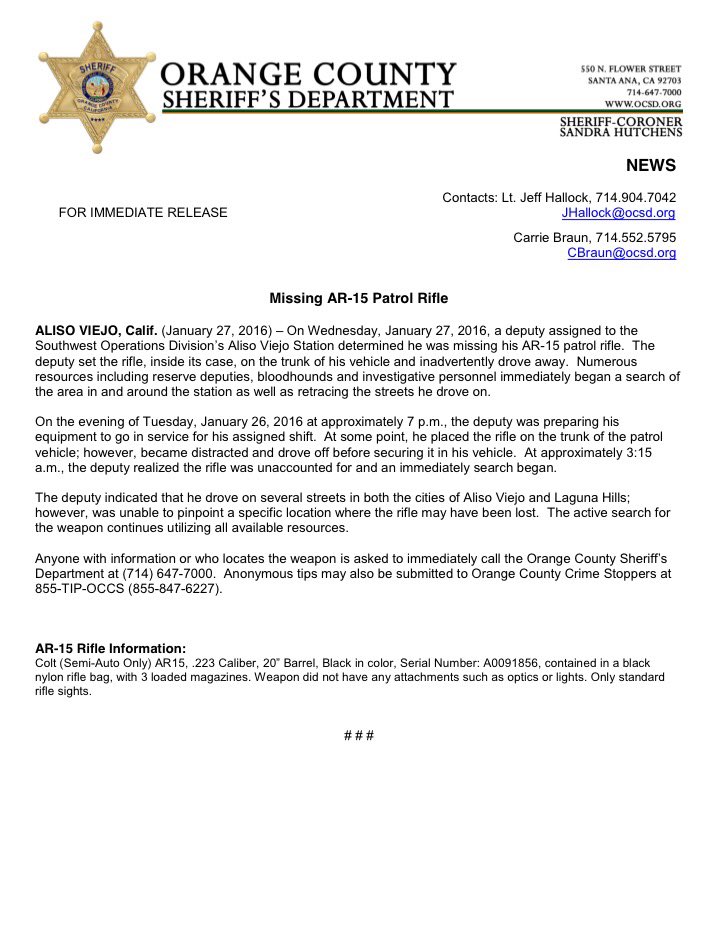
I guess this is the day of stupid stuff


Embedded image permalink
https://twitter.com/OCSD

Hundreds of DHS badges, guns, cell phones lost or stolen since 2012

Feb. 20, 2014: A U.S. Customs and Border Protection arm patch and badge is seen at Los Angeles International Airport, California.
Feb. 20, 2014: A U.S. Customs and Border Protection arm patch and badge is seen at Los Angeles International Airport, California. (Reuters)
Hundreds of badges, credentials, cell phones and guns belonging to Department of Homeland Security employees have been lost or stolen in recent years -- raising serious security concerns about the potential damage these missing items could do in the wrong hands.
Inventory reports, obtained by the news site Complete Colorado and shared with FoxNews.com, show that over 1,300 badges, 165 firearms and 589 cell phones were lost or stolen over the span of 31 months between 2012 and 2015.
The majority of the credentials belonged to employees of Customs and Border Protection (CBP), while others belonged to Immigration and Customs Enforcement (ICE) and U.S. Citizenship and Immigration Services (USCIS) employees.
The lost or stolen guns also mostly belonged to CBP employees, though others were cited as belonging to TSA and ICE workers. The agencies all fall under DHS. 
The missing badges and guns suggest a shocking lack of security from federal law enforcement officers and represent a significant security risk, experts say.
“It’s scary that you’d have that number of credentials out there that someone could manipulate,” Tim Miller, a retired Secret Service special agent, told FoxNews.com.
While Miller said the phones are likely to have enough protocols in place to prevent them from being used for nefarious purposes, the badges and credentials are an entirely different matter and could allow access to sensitive areas such as cargo.
“The thing that’s particularly concerning is that if you get real credentials, it’s very easy to manipulate them, and you’ve got someone else’s picture on what law enforcement would see as valid," Miller said. "Then you factor in terrorism, it’s a significant concern that people would run around with authentic credentials and be able to access areas they wouldn’t otherwise be able to access.” 
When reached for comment, DHS did not dispute the inventory report data -- which Complete Colorado, a Colorado-based online news site, had obtained via a Freedom of Information Act request. The reporter who obtained the data also works with Denver-based free-market think tank the Independence Institute. 
In a statement to FoxNews.com, a DHS spokesman said they strive to be “good stewards of government resources” and have improved oversight and reduced the number of lost or stolen items over the past few years.
“If a credential holder loses or has their credentials stolen, the holder must report the incident to their supervisor and credential issuance office immediately,” spokesman Justin Greenberg said. “Once the incident has been reported, this information is entered into appropriate DHS and law enforcement databases, which disables use of the lost or stolen item.”
He also noted that DHS encrypts all mobile devices, laptops and tablets.
Miller said officials need to be doing more, considering the sheer number of guns and badges that have been lost or stolen.
Lawmakers also have expressed concern about the safety of DHS property in the past. In December, the Senate Commerce, Science, and Transportation Committee approved legislation that would tighten screening of TSA workers, review security protocols and increase fines and enforcement requirements related to missing credentials.
The legislation was put forward after members of the committee wrote to TSA officials in March expressing concern about reports of unaccounted TSA badges, and the reported use of badges to bypass security checkpoints.
“Officials entrusted with protecting the American public cannot consider the loss of sensitive items normal or routine," Sen. John Thune, R-S.D., chairman of the committee, told FoxNews.com.
"When the Commerce Committee looked at lost and missing airport security credentials, we discovered that existing rules weren’t being effectively enforced. Mistakes happen, but if we don’t work to eliminate them and insist on accountability, then we’re left with unacceptable risk,” Thune said.
 
http://www.foxnews.com/politics/2016/01/27/hundreds-dhs-badges-guns-cell-phones-lost-or-stolen-since-2012.html
 
Danish teen fought off her attacker - now she'll face fine
Police said the girl will be fined, even though the pepper spray stopped her attacker. Photo: Colourbox

Danish teen fought off her attacker - now she'll face fine

A 17-year-old girl who was physically and sexually attacked in Sønderborg will herself face charges for using pepper spray to fend off her assailant.
 
The teenager told police that she was attacked in central Sønderborg on Wednesday at around 10pm by a dark-skinned English-speaking man. She said the man knocked her to the ground and then unbuttoned her pants and attempted to undress her. 
 
The girl was able to save herself from further assault by using pepper spray on the attacker, but now she may be the one who ends up in legal trouble. 
 
“It is illegal to possess and use pepper spray, so she will likely be charged for that,” local police spokesman Knud Kirsten told TV Syd. 
 
The case has sparked a backlash among some Danes who point to increasing reports of sexual harassment in Sønderborg and other Danish cities at the same time that police say they are stretched too thin to properly carry out their duties. 
 
Numerous readers wrote in the comments section on TV Syd’s story about the incident that they would be willing to pay the girl’s fine, which will most likely be 500 kroner. 
 
The man who attacked the 17-year-old fled from the scene and has not been charged. 
 
Sexual assaults have been in the news in Sønderborg recently after several women in the town reported earlier this month that they sometimes feel harassed by the aggressive behaviour of some male asylum seekers and refugees at the local asylum centre. 
 
It is not known, however, if the assailant in this latest incident was an asylum seeker or refugee.
 
In related news, a nightclub in Sønderborg is now barring guests from entering if they cannot speak Danish, English or German. Other Danish nightclubs are also reportedly considering similar moves.