Peter Boockvar – What Is Really Happening In China May Surprise People
On the heels of a failed coup attempt in Turkey and continued uncertainty in global markets, Peter Boockvar notes that what is really happening in China may surprise people. Here is what Peter Boockvar wrote today as the world awaits the next round of monetary madness: I have to admit, a Turkish coup or even an attempt at one was not on my list of focus. I’ll leave the consequences for others to discuss but realize that most geopolitical events are not market relevant for more than a few days and this may very well be just a Turkish thing. That said, disgust with the ruling class is being seen again. As we get bombarded over the next few weeks with Q2 earnings, I’ll say what I seem to say quarterly. Expect about 70% of companies to beat earnings estimates. That is the benchmark so a beat rate around that level should not be considered good, it should be referred to as normal. The pound is rallying again after BoE member Martin Weale said an August ease is not set in stone. “For there to be a case for easing policy I will need to expect weakness in output to be large enough more than to compensate for any overshoot in inflation.” They only have 50 bps to play with as most on the MPC don’t believe in negative interest rates. The line of the day though from Weale was this, “The old Lady of Threadneedle Street is not a nurse to markets.” We’ll see if he means it because any further amount of easing will not result in one bit of benefit to their economy as only costs are being built up. The ECB meets on Thursday and no added policy changes are expected. After all, Mario Draghi is already killing his banking system, starving the region’s pension systems and bankrupting insurance companies for no discernible benefit. At what point does a central banker say “We’ve gone too far”? What Is Really Happening in China May Surprise People The number of price gains in 70 China cities surveyed moderated on a m/o/m basis. For new apartments, prices rose in 55 cities in June vs 60 in May and 65 in April. In December there 39 cities that saw price increases. For existing apartments prices rose in 48 cities, down 1 from May and down 3 from April. In December it was at 37. On a y/o/y basis for both new and existing apartments however, prices grew in even more cities than the month prior. Price gains are still out of control in the major cities with Shenzhen seeing a 47% y/o/y increase but that is actually down from 53% in May. Prices in Shanghai were up 28% vs last year, the same pace as the prior month and they were higher by 20% in Beijing. Acknowledging the bubbles, these cities have taken steps to curb the enthusiasm by raising down payment requirements for 2nd homes among other things. Prices in 2nd tier cities slowed. Bottom line, Chinese government policy remains all about managing the excesses that have built up over the past 7 years in order to slow the pace of growth in an orderly manner. Smoke and mirrors is how they are doing it but the process continues. Either way, as seen in the US, it is taking more and more debt to generate the same level of economic growth. The Shanghai property stock index fell .7% in response to the m/o/m price slowdown while the Shanghai comp was lower by .4%. The yuan was also softer with it now above 6.70 vs the US dollar for the 1st time in 5 yrs. The H share index though was up by .5% with most of Asia modestly up. Copper is down about 1%.
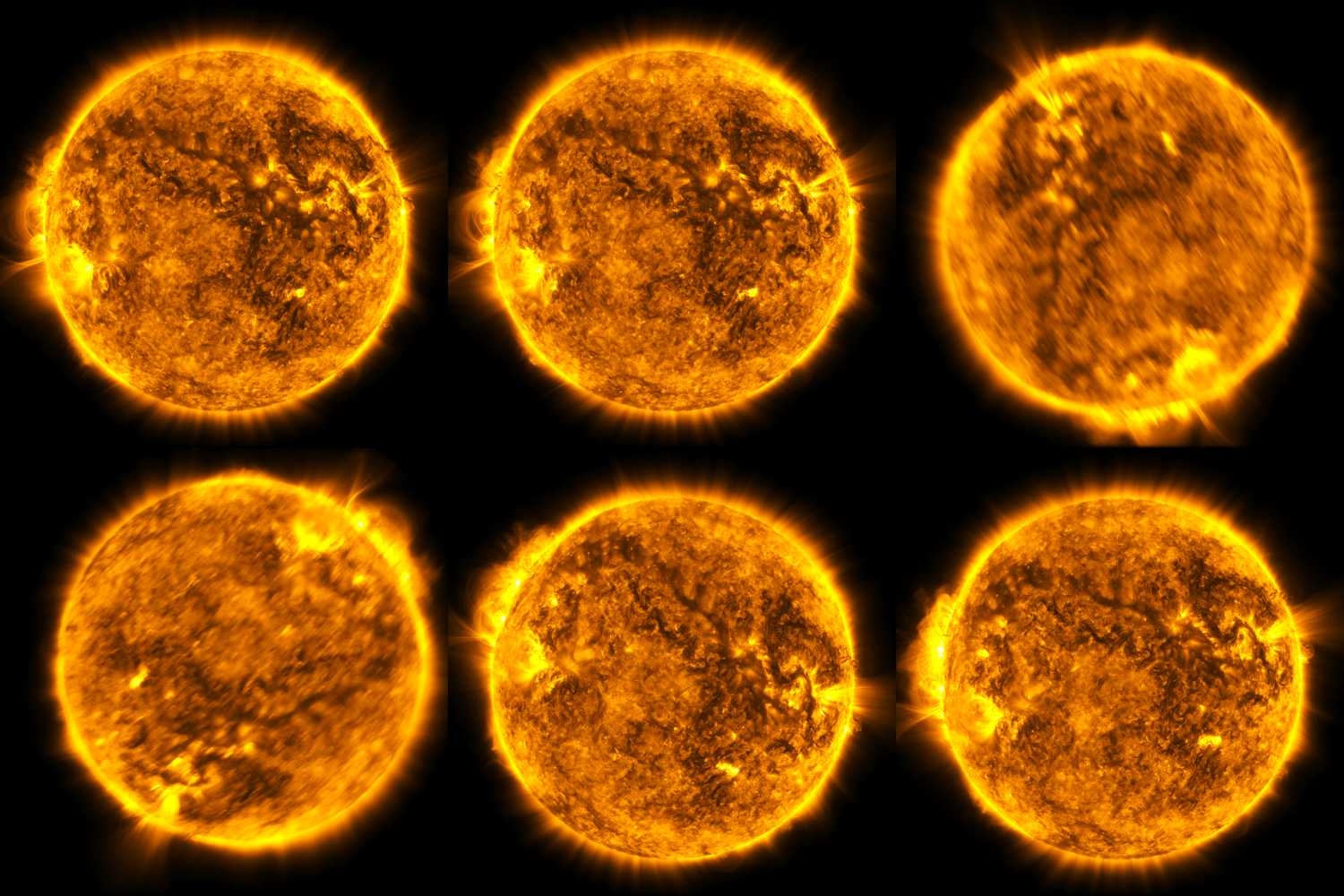
The sun appears to take a dizzying flip in a new video captured by NASA's Solar Dynamics Observatory (SDO) spacecraft . SDO did a full somersault on July 6 over the course of about 7 hours, taking pictures of the sun every 12 seconds all the while. These photos, which SDO team members combined into a video, are pretty wild. The video seems "to show the sun spinning, as if stuck on a pinwheel," NASA officials wrote in an image description Friday (July 15).
The sun appears to do a somersault in these images captured by NASA's Solar Dynamics Observatory (SDO) spacecraft on July 6, 2016 — but SDO was the one doing the spinning.
Credit: NASA’s Goddard Space Flight Center/SDO/Joy Ng SDO does such a somersault twice a year to help its Helioseismic and Magnetic Imager (HMI) instrument take good measurements of the sun's outer edge. "Were the sun perfectly spherical, this would be a much simpler task. But the solar surface is dynamic, leading to occasional distortions," NASA officials wrote. "This makes it hard for HMI to find the sun’s edge when it’s perfectly still. HMI’s biannual roll lets each part of the camera look at the entire perimeter of the sun, helping it map the sun’s shape much more precisely."
Extreme solar storms could be more common than expected
Analysis of ice cores finds two severe events occurred in the last 1,300 years.
An X1.6 class solar flare flashes in the middle of the sun on Sept. 10, 2014.
NASA/SDO
Scientists studying ancient ice cores extracted from Greenland and Antarctica have found further evidence of two very powerful solar storms in the last 1,300 years, raising concerns about similar events in the future. Extreme solar storms pose a threat to all forms of electronic technology.
In 2012, Japanese scientists first reported the discovery of a spike of carbon-14 in cedar trees on that island during the AD 774-775 time frame. Since then, similar spikes have been observed in tree rings from the same era obtained on other continents. And thanks to a college biochemistry student, scientists have rooted the event in history through a reference in the Anglo-Saxon Chronicle, which cites a “red crucifix” appearing in the heavens after sunset in the year 774. It hasn't been entirely clear what caused this radioactive spike, however, and exotic theories such as a giant comet hitting the Sun or a nearby supernova have been put forward to explain it. Now researchers led by geologist Raimund Muscheler of Lund University in Sweden say they have solved the mystery of both the 774-775 AD event as well as a similar one in 993-994 AD. In addition to carbon-14, they have linked radioactive beryllium to both events, firmly establishing them as solar flares. “In this study we have aimed to work systematically to find the cause for these events," Muscheler said. "We have now found corresponding increases for exactly the same periods in ice cores. With these new results it is possible to rule out all other suggested explanations and thereby confirm extreme solar storms as the cause of these mysterious radiocarbon increases.”
The new analysis of these past solar storms also confirms that they were several times stronger than the most intense solar storms that have been recorded on Earth. The largest solar flare ever measured came in 1859, during the so-called Carrington Event. Named for British astronomer Richard Christopher Carrington who discovered and tracked the solar outburst, the event disrupted telegraph service around the world. In 2013, Lloyd's of London and the Atmospheric and Environmental Research Center estimated that the duration of power outages during a Carrington-like event today could last five months or longer for 20 to 40 million Americans at a total economic cost of $0.6-2.6 trillion. Additionally, were an event the magnitude of the AD 774 or AD 993 solar storms to occur today, the study authors say it would critically disrupt satellite-based technology and means of communication. They urged a reassessment of the risks associated with very intense solar storms, which may very well occur more frequently than currently believed.
$20 trillion man: National debt nearly doubles during Obama presidency When President Obama signs into law the new two-year budget deal Monday, his action will bring into sharper focus a part of his legacy that he doesn’t like to talk about: He is the $20 trillion man. Mr. Obama’s spending agreement with Congress will suspend the nation’s debt limit and allow the Treasury to borrow another $1.5 trillion or so by the end of his presidency in 2017. Added to the current total national debt of more than $18.15 trillion, the red ink will likely be crowding the $20 trillion mark right around the time Mr. Obama leaves the White House. http://www.washingtontimes.com/news/2015/nov/1/obama-presidency-to-end-with-20-trillion-national-/
German Schools Abolish Christian Festival to Avoid Offending Muslim Migrants
St. Martin's Day celebration amended to "facilitate the integration" of asylum seekers
Tech bubble: This is ‘money in your mattress’ time
Funding for tech start-ups appears to be going strong, but there's a looming concern that it could be too strong — strong enough that it's already fueled the next tech bubble.
Some investors and analysts have been reluctant to say outright that we're in the midst of overgrowth in tech.
Fifteen years ago, the sector was relatively young, but now with established tech companies like Apple, Microsoft and Facebook leading the charge and better tech representation among the S&P 500, the industry has matured, according to Angelo Zino, analyst at S&P Capital IQ, in a phone interview.
But relatively firm-footed tech giants are one thing. Start-ups are an entirely different world. The market for tech start-ups today may be just as speculative as it was during the first bubble, suggested Nick Bilton, technology and business columnist at The New York Times.
"The valuations of companies are just completely out of whack and no one has any idea where these numbers are coming from," Bilton said in an interview with CNBC, adding that the existence of billion-dollar start-up "unicorns" in tech, is a major sign that we're in a tech bubble.
Among those unicorns is ride-hailing company Uber, worth $51 billion; electronics company Xiaomi, worth $46 billion; and short-term apartment rental site Airbnb, worth $25.5 billion, according to a recent Fortune ranking.
Petrovich9 | Getty Images
Bilton points to the skyscraper index as further evidence of a new tech bubble.
"At the beginning of every bubble burst or every recession, there's always been a race to build the biggest skyscrapers in the world. And it's usually from money that has come in from bubble-gotten gains," he said. "Often when you have these buildings built, there isn't anyone to fill them and it starts to be one of the things that causes the bubble to burst," Bilton posited.
The skyscraper indicating a bubble this time around, according to Bilton, is the Salesforce Tower, which is currently under construction. That skyscraper is expected to stand 200 feet higher than the Transamerica Pyramid, which is currently the tallest building on the San Francisco skyline.
But whether there's a bubble at risk of bursting or just some high-flying start-ups that need to gear up for a descent, Bilton seems conservative.
"My best advice to protect yourself is put your money in your mattress," Bilton said.
"Most venture capitalists … are absolutely comfortable with tech companies needing time to reach profitability," said Tony Tjan, CEO and managing partner at venture capital firm Cue Ball Capital, in an email.
"What you are looking for first and foremost is great people. Human capital matters more than anything in good and bad markets," Tjan said.
Solar activity predicted to fall 60% in 2030s, to 'mini ice age' levels: Sun driven by double dynamo
Date:
July 9, 2015
Source:
Royal Astronomical Society (RAS)
Summary:
A new model of the Sun's solar cycle is producing unprecedentedly accurate predictions of irregularities within the Sun's 11-year heartbeat. The model draws on dynamo effects in two layers of the Sun, one close to the surface and one deep within its convection zone. Predictions from the model suggest that solar activity will fall by 60 per cent during the 2030s to conditions last seen during the 'mini ice age' that began in 1645.
FULL STORY
Montage of images of solar activity between August 1991 and September 2001.
A new model of the Sun's solar cycle is producing unprecedentedly accurate predictions of irregularities within the Sun's 11-year heartbeat. The model draws on dynamo effects in two layers of the Sun, one close to the surface and one deep within its convection zone. Predictions from the model suggest that solar activity will fall by 60 per cent during the 2030s to conditions last seen during the 'mini ice age' that began in 1645.
Results will be presented today by Prof Valentina Zharkova at the National Astronomy Meeting in Llandudno. It is 172 years since a scientist first spotted that the Sun's activity varies over a cycle lasting around 10 to 12 years. But every cycle is a little different and none of the models of causes to date have fully explained fluctuations. Many solar physicists have put the cause of the solar cycle down to a dynamo caused by convecting fluid deep within the Sun. Now, Zharkova and her colleagues have found that adding a second dynamo, close to the surface, completes the picture with surprising accuracy. "We found magnetic wave components appearing in pairs, originating in two different layers in the Sun's interior. They both have a frequency of approximately 11 years, although this frequency is slightly different, and they are offset in time. Over the cycle, the waves fluctuate between the northern and southern hemispheres of the Sun. Combining both waves together and comparing to real data for the current solar cycle, we found that our predictions showed an accuracy of 97%," said Zharkova. Zharkova and her colleagues derived their model using a technique called 'principal component analysis' of the magnetic field observations from the Wilcox Solar Observatory in California. They examined three solar cycles-worth of magnetic field activity, covering the period from 1976-2008. In addition, they compared their predictions to average sunspot numbers, another strong marker of solar activity. All the predictions and observations were closely matched. Looking ahead to the next solar cycles, the model predicts that the pair of waves become increasingly offset during Cycle 25, which peaks in 2022. During Cycle 26, which covers the decade from 2030-2040, the two waves will become exactly out of synch and this will cause a significant reduction in solar activity. "In cycle 26, the two waves exactly mirror each other -- peaking at the same time but in opposite hemispheres of the Sun. Their interaction will be disruptive, or they will nearly cancel each other. We predict that this will lead to the properties of a 'Maunder minimum'," said Zharkova. "Effectively, when the waves are approximately in phase, they can show strong interaction, or resonance, and we have strong solar activity. When they are out of phase, we have solar minimums. When there is full phase separation, we have the conditions last seen during the Maunder minimum, 370 years ago."
The calm before the solar storm? NASA warns 'something unexpected is happening to the Sun'
'Something unexpected' is happening on the Sun, Nasa has warned.
This year was supposed to be the year of 'solar maximum,' the peak of the 11-year sunspot cycle.
But as this image reveals, solar activity is relatively low.
Scroll down for video
Sunspot numbers are well below their values from 2011, and strong solar flares have been infrequent, as this image shows - despite Nasa forecasting major solar storms
'Sunspot numbers are well below their values from 2011, and strong solar flares have been infrequent,' the space agency says. The image above shows the Earth-facing surface of the Sun on February 28, 2013, as observed by the Helioseismic and Magnetic Imager (HMI) on NASA's Solar Dynamics Observatory. It observed just a few small sunspots on an otherwise clean face, which is usually riddled with many spots during peak solar activity. Experts have been baffled by the apparent lack of activity - with many wondering if NASA simply got it wrong. However, Solar physicist Dean Pesnell of NASA’s Goddard Space Flight Center believes he has a different explanation. 'This is solar maximum,' he says. 'But it looks different from what we expected because it is double-peaked.' 'The last two solar maxima, around 1989 and 2001, had not one but two peaks.' Solar activity went up, dipped, then rose again, performing a mini-cycle that lasted about two years, he said.
The same thing could be happening now, as sunspot counts jumped in 2011 and dipped in 2012, he believes. Pesnell expects them to rebound in 2013: 'I am comfortable in saying that another peak will happen in 2013 and possibly last into 2014.' He spotted a similarity between Solar Cycle 24 and Solar Cycle 14, which had a double-peak during the first decade of the 20th century. If the two cycles are twins, 'it would mean one peak in late 2013 and another in 2015'.
An asteroid the size of a city block will pass by Earth this weekend, but have no fear: There's no danger of it hitting our planet. The 80-meter (262 feet) wide asteroid makes its closest approach to Earth on Saturday afternoon in the United States. It will be about 975,000 kilometers (604,500 miles) away, said Don Yeomans, a planetary scientist at NASA's Jet Propulsion Laboratory in California. That's about 2 1/2 times the distance from the Earth to the moon. "It's a pretty good size, but it's not getting that close, at least by recent standards," Yeomans said. The asteroid was only discovered Sunday because search telescopes can't find objects of that size until they get close. Now that it's in view, Yeomans said, astronomers can accurately chart its orbit. And they assure us this space rock will only make a fly-by. The asteroid is already observable in the night sky, even with sophisticated amateur telescopes, he said. But get a good look at it now, because after the close approach, the asteroid will appear in the daytime sky and be harder to see, Yeomans said. Dubbed 2013ET (which is simply code for when it was discovered), the asteroid is the latest object from space to come near our planet. A meteor exploded over southwestern Russia last month, injuring more than 1,500 people, Russian authorities said. In what astronomers have said was an unrelated coincidence, a larger asteroid passed by Earth the same day, about 17,100 miles away at its closest. This Friday, a comet called Pan-STARRS will come into view over the Northern Hemisphere. A second comet, called ISON, may be visible in November. Scientists say neither comet poses a threat to Earth.