Showing posts with label Shelters. Show all posts

Wednesday, August 10, 2016

Wednesday 08-10-16

This Tiny Cardboard Home Takes Only 1 Day To Build & Lasts 100 Years

Tiny homes have become a social movement we can’t ignore. People all over the world are choosing to downsize the space they live in for a happier life.
In the U.S., for instance, the typical American home is around 2,600 square feet, but the typical tiny home is only between 100 and 400 square feet. They come in all shapes, sizes, and forms, but they all have one thing in common: they allow simpler living in a smaller, more efficient environment.
People have joined this movement for many reasons, whether it be concerns over the environment or their own finances or the desire for more time and freedom. Most Americans spend one-third to one-half of their entire income on their homes, which means they spend 15 years working just to pay for it.
This has caused 76 percent of Americans to live paycheck to paycheck. But for what? People who turn to this movement are done trying to prove themselves. They just want a lifestyle that can make them feel good from the inside out.
The Cardboard Home
As mentioned above, tiny homes come in many forms. But have you heard of one made out of cardboard? While most people wouldn’t think this type of material to be suitable for building a comfortable and safe abode, award-winning architects have discovered how to use it to produce remarkably sturdy and reliable shelters. Dutch design studio Fiction Factory has created a design for a tiny “micro home” using cardboard. Complete with a multitude of applications, such as disaster relief, they claim it can last up to 100 years.
Called the Wikkelhouse, or “wrapper house,” the home is made of tough corrugated cardboard panels that adhere to each other with a non-toxic and environmentally-friendly glue.
Instant Access to Current Spot Prices & Interactive Charts
2
3
4
8
10
13
How It Works
A large spindle is used to wrap the glued layers of cardboard around the dwelling’s pre-fabricated modular segments a total of 24 times. This makes for a well-insulated and strong structure. The 1.2-meter (47 inches) thick, 500-kilogram (1,100 pounds) modules are then combined and assembled to create a bigger structure that doesn’t require a permanent foundation.
As for keeping out the elements, the cardboard is coated with a waterproof, breathable film calledMiotex, and topped off with an open façade siding system of pine slats. So long as the coating is reapplied at least every 30 years, this style of home is thought to last for decades.
wwet
Easy And Eco-Friendly
This design makes way for an almost infinite number of layouts and a variety of sizes. The assembly of the home takes a mere day or two to complete, and the modules can be transported almost anywhere to be reused. They are also mostly recyclable.
Windows can be added on wherever you so please, and different areas such as a kitchen, bathroom and shower can be included using “smart home-segments.” The interiors are completed with plywood paneling for the walls to provide a naturally-minimalistic atmosphere.
The Cost Of A Wikkelhouse
Whole most people spend the bulk of their money just to live in their home, that’s not the case with this innovative style of housing, as each one costs approximately $4,500 USD. A completed version of a basic Wikkelhouse comes in at around $80,000 USD. Quite a bit cheaper and much more eco-friendly than a typical home, the idea is fascinating and provides just one more approach to the social movement away from bigger homes.
The company is currently working on an off-grid, more self-sustainable model, so stay tuned!

https://www.lewrockwell.com/2016/08/no_author/tiny-cardboard-home/

Chemtrails are Greatest Threat to Life on Earth-Dane Wigington


By Greg Hunter’s USAWatchdog.com
Last month, CIA Director John Brennan admitted Chemtrails, or as he put it, “Stratospheric Aerosol Injection,” is established geoengineering science used to fight global warming. Geoengineering researcher Dane Wigington says if the government is admitting it, the negative effects of spraying are too big to hide much longer. Wigington explains, “When CIA Director Brennan has to address it publicly, clearly it’s getting very difficult for them to hide this elephant in the room and the damage it has done, not only to the environment, but to us. It is irreparable already, and they know the liability already. They know this. They also know the amount of liability that has been created. That’s why they have been so desperate to hide this. To put this into the nutshell, the amount of destruction these programs have caused environmentally, it’s contaminated the entire web of life. This is, mathematically speaking, the greatest and most immediate threat to the web of life on earth, including human health. It is greater than any other threat short of nuclear cataclysm. That’s a mathematical fact.”
Wigington is the founder of GeoEngineeringWatch.org and has teamed up with pro bono lawyers to sue the U.S. government to expose and stop the spraying. Wigington contends, “A 60 day notice has been put together by our team of U.S. attorneys to put all those potential defendants (which include Secretary of Defense Ash Carter and many others) on notice that this litigation is pending. They have been notified by certified mail, a 33 page 60 day notice . . . a very comprehensive document that outlines what they are doing, what laws its breaking and why this suit is being filed.”
Wigington goes on to say, “This is indisputable fact. What these programs have done, full deployment over 70 years ago, are breaching countless environmental laws and countless laws for protections of populations. This is an unbelievably egregious act and a willful assault on the population. It can’t be called anything else. It’s just been under the radar for so long because our completely controlled corporate media is doing everything they can to try to suppress this most important issue from the public as long as they can.”
The high ranking people in the scientific community have also been covering up chemtrails and geoengineering for decades. Wigington told one official via email exchange, “The wake up is real, and we have documentation to back up our accusations. Once the public finds out what’s been done to them, they will hold them responsible. Not just the ones who have done these crimes, but people facilitating these crimes by people helping to hide them like Marcia McNutt (President of the National Academy of Sciences). The public, at some point, would hold Nuremberg type trials. We are talking about ecocide and omnicide (extinction of human species). We are talking about a population that has been irreparably damaged by these programs. The heavy metals build up in our system, and they do immense amounts of harm. You can’t fix that, and once the population knows what’s been done to them, people . . . will be held accountable.”
Join Greg Hunter as he goes One-on-One with Dane Wigington of GeoEngineeringWatch.org.
(There is much more in the video interview.)

After the Interview:
I also asked Wigington about the reports of improving drought conditions in his home state of California. Wigington told me, “The drought in California is worse, and the notion that it is better is an absolute fallacy. Whole forests are being wiped out, and springs are drying up faster than ever before. High temps are being under reported by four or five degrees, and overnight temps are much higher than normal.”

 http://usawatchdog.com/chemtrails-are-greatest-threat-to-life-on-earth-dane-wigington/?utm_source=feedburner&utm_medium=feed&utm_campaign=Feed%3A+UsaWatchdog+%28Greg+Hunter%E2%80%99s+USAWatchdog%29

Friday, April 15, 2016

Friday 04-15-16

Panicked Elite Buying Bomb-Proof Luxury Survival Bunkers to Escape Civil Unrest, Disasters

Panicked members of the elite are buying luxury bomb-proof underground survival bunkers because they fear mass civil unrest might be on the horizon.
The company behind the construction of the sprawling complexes, Vivos, says the facilities are for the “protection of high net worth individuals” in the event of apocalyptic-style scenarios during which “millions will perish or worse yet, struggle to survive as victims”.
“Where will you go when pandemonium strikes?” asks a promo for the luxury shelters.
The biggest facility, called Europa One, is located in Germany and is “one of the most fortified and massive underground survival shelters on Earth, deep below a limestone mountain” and is “safely secured from the general public, behind sealed and secured walls, gates and blast doors”.
Journalist Lynn Parramore said she also visited another facility in Indiana which is a former Cold War communications facility.
“Built during the Cold War to withstand a 20 megaton blast, within just a few miles, this impervious underground complex accommodates up to 80 people, for a minimum of one year of fully autonomous survival, without needing to return to the surface,” states a promo for the bunker on the Vivos website.
The main selling point is the location of the facility, which is a “safe distance away from the New Madrid fault line” and therefore a good hideaway to escape a “tsunami-type event”.
“You go underground and it feels like you’re in a very nice hotel,” said Parramore.
“This is for wealthy people who are concerned about various disaster scenarios, but a common theme among them is a fear of civil unrest, a fear of an uprising from the 99%,” she added.
Units in some of the underground shelters, which also come with a year’s supply of food and water, start at around $35,000 dollars but the largest ones sell for upwards of $3 million dollars.
“There is no assurance that our race will continue, therefore it is our responsibility to do everything we can to survive,” warns the Vivos website, which invites elitists to contact them for further information that is on a “need to know” basis only.
As we reported last week, millionaires are fleeing Chicago and other major cities due to concerns over racial tensions and rising crime rates.
“About 3,000 individuals with net assets of $1 million or more,” left Chicago in just the last year alone according to the Chicago Tribune.
Paris and Rome are also seeing a mass exodus of millionaires, while wealthy elites are also installing panic rooms in their big city apartments due to fears over potential civil unrest and skyrocketing crime.
Land and remote homes in places like New Zealand are also popular with the global 1%, with realtors citing the threat of worldwide financial instability and domestic disorder as motivating factors behind the purchases.


OPM Seeks Social Media Tracking for Background Checks

 
The Office of Personnel Management is preparing for a pilot program to automatically track public social media postings of people applying for security clearances.
OPM is conducting market research to find companies that can perform automated social media tracking and other types of Web crawling as part of the background investigation process, according to an April 8 request for information posted online. Responses from interested companies are due by April 15.
OPM is looking for companies that can automatically browse “publicly available electronic information,” which includes information posted to news and media sites; Facebook, Twitter and other social media postings; blog postings; online court records, updates to photo and video-sharing sites; and information gleaned from online e-commerce sites, such as Amazon and eBay.
OPM is interested in companies that have fully automated capabilities -- “with no human intervention,” according to the RFI -- with the ability to search for information “in the parts of the World Wide Web whose contents are not indexed by standard search engines.”
Companies should also have a “robust identity matching algorithm” that won’t get tricked by similar names and return irrelevant results.
The pilot project tests the feasibility of obtaining social media tracking from commercial vendors and will be a joint effort between OPM, which is responsible for performing most federal employee background checks, and the Office of the Director of National Intelligence, according to an OPM spokesman.
Testing of the new tech will be conducted on a population of 400 investigations, the spokesman said, although there’s still no word on when the pilot project is set to get underway.
The new solicitation is the latest in a series of government initiatives to explore the use of social media in the background investigation process. Some of these efforts have been stymied by missed deadlines and unclear policy.
Pentagon and intelligence officials are leading an effort to establish “continuous evaluation” of clearance-holders using automated data checks to replace periodic reinvestigations that currently occur only once every five or 10 years.
Intelligence officials had planned to have a continuous evaluation capability in place for the most sensitive clearance holders by December 2014 but missed the deadline, according to progress updates posted on Performance.gov. Officials now plan to roll out the new program in phases, with at least 5 percent of top-secret clearance holders being continuously evaluated by March 2017. As of December, about 225,000 personnel undergo the automatic checks.
A public-records continuous evaluation project is also currently underway at the State Department, according to the Performance.gov update.
At a hearing in February, federal officials told lawmakers they were still working out the kinks in government policy for more widespread use of social media in the clearance process.
Last June, OPM awarded a sole source contract to California-based tech company Social Intelligence for a preliminary pilot program examining social media in the clearance process.
Under the terms of the contract, Social Intelligence, which has also participated in DOD social media pilots, was to provide 400 reports of publicly available online information over the following six to nine months.
The security clearance process has been rocked by controversy in recent years.
Last summer, OPM announced it had fallen victim to a massive data breach affecting millions of background investigation records. Even earlier, critics raised questions about OPM’s handling of background checks, pointing to potential missed red flags in the backgrounds of National Security Agency contractor Edward Snowden and other so-called “insider threats.”
In January, the Obama administration announced plans to overhaul the process, establishing a new National Background Investigations Bureau and tasking the Defense Department with the responsibility for storing and securing sensitive files.

http://www.nextgov.com/cio-briefing/2016/04/opm-seeking-social-media-tracking-background-checks/127380/

Thursday, October 15, 2015

Thursday 10-15-15

Texas Rancher Fights Back Against BLM Land Grab

"It is a land grab... As far as I am concerned, this is private property"
Aderholt’s family has had a deed to the land since 1941, and he had hoped to pass the property and the family business on to his sons.
“They come down here a lot and play,” Aderholt told KAUZ News Channel 6. “They help with the cattle and help building fences. They are very interested in hanging round here and helping me out.” But according to the Bureau of Land Management, the same federal government agency that confronted Nevada rancher Cliven Bundy in 2014, some of that land belongs to the feds, and they want the Aderholts off it. Furthermore, the BLM claims the deed that proves Aderholt’s ownership of the land, given to his parents by the State of Texas, is worthless. “The BLM is saying we should have never had a deed to it. That Texas should have never produced that deed,” Aderholt said. The rancher concedes the BLM is entitled to land “along the gradient boundary,” according to KAUZ, which Aderholt says is dependent on “the way the water washes and cuts into different properties.” But the BLM argues the real boundary lies a half mile inland from the river, which cuts into 600 acres of Aderholt’s land. KAUZ reports the BLM’s efforts could leave Aderholt and his family homeless, as his “house is located inside the 600 acres the BLM wants to claim.” Despite never bothering him for the last 70 years, the feds aren’t offering Aderholt an explanation for what they plan to do with the land. “They could own it, they could turn it to the public, they could condemn it, they could sell it back to me,” Aderholt says. “It is a land grab,” Aderholt insists. “As far as I am concerned, this is private property.”

Watch: Although no gunshots were fired, what happened at the Bundy Ranch was a shot fired across the bow using the most powerful weapon in the infowar, the camera. It captured the iconic moment of the people taking on an aggressive government tyranny, a snapshot that still reverberates one year later. We look at the lies, the spin and the reality of a federal government openly defying The Posse Comitatus Act as it threatened and brutalized citizens of the community. Although the sheriff did nothing to protect the community, neighbor stood with neighbor in true posse comitatus, the “power of the community”, to expel the federal army from the community.
 

Thinking Outside the Box by Moving Into One

OAKLAND, Calif. — This summer, the median rent for a one-bedroom in San Francisco’s cityscape of peaked Victorians soared higher than Manhattan’s, sent skyward by a housing shortage fueled in part by the arrival of droves of newcomers here to mine tech gold.

And so, as the story of such cities goes, the priced-out move outward — in New York City, to Brooklyn and, increasingly, to Queens. For San Franciscans, the rent refuge is here in Oakland, where the rates are increasing as well — so much so that young professionals are living in repurposed shipping containers while the homeless are lugging around coffinlike sleeping boxes on wheels.

These two improvised housing arrangements have emerged in an industrial pocket of Oakland where the median rent has gone up by 20 percent over the past year. One, in a warehouse, is called Containertopia, a community of young people who have set up a village of 160-square-foot shipping containers like ones used in the Port of Oakland. Each resident pays $600 a month to live in a container, which can be modified with things like insulation, glass doors, electrical outlets, solar panels and a self-contained shower and toilet.
Photo
Heather Stewart at Containertopia in Oakland, Calif. Ms. Stewart created Containertopia, a village of 160-square-foot shipping containers, with Luke Iseman. Credit Jim Wilson/The New York Times
Containertopia was started last year by Luke Iseman, 32, and Heather Stewart, 30, who were then a couple. For Mr. Iseman, who graduated from the University of Pennsylvania’s Wharton School and works in technology — most recently developing automated systems for watering plants — container living has been a social experiment in stripping down to the basics, one that he hopes to teach others to replicate.
“If we can do it in one of the highest-cost places in the world,” he said, “people can do this anywhere.”
Just outside the warehouse doors is another community, residing, too, in containers of a sort. Here, the homeless live in dwellings made by a local artist named Gregory Kloehn, set on wheels and made for the streets. Each is about eight feet long and tall enough for a person to sit up in.
“It doesn’t fit our mind-set of what a home is,” said Mr. Kloehn, 44, who began creating and giving away the portable homes, which are made of recycled material, in 2011. Oakland has about 3,000 homeless people, according to the East Oakland Community Project, a nonprofit organization that helps house people who live on the street; San Francisco has about 6,700.
Mr. Kloehn has made about 40 of the cheerily painted rolling boxes, coaxing people to leave their cardboard or tarp shanties on the streets.
Photo
Gregory Kloehn, an artist, uses recycled materials to build containers, about eight feet long and on wheels, that people can live in. He gives them away to homeless people in Oakland, Calif. Credit Jim Wilson/The New York Times
“In this city, with all its money, within it there is another layer: these nomadic people who are living off our garbage,” he said.
Containertopia and Mr. Kloehn’s mobile shelters draw from the tiny house movement, a shift to a more ascetic way of living that has inspired entire microhome villages in places like Olympia, Wash., and Madison, Wis., as well as isolated examples in countless backyards. Such residences are embraced by the ecologically and social-justice minded, but are often fought by local governments; they often do not comply with building codes or are plopped in areas where they should not be.
But that is where the similarities between the homeless dwellings and the shipping containers end. Though they are on the same block, they are worlds apart.
Ms. Stewart and Mr. Iseman initially set Containertopia in an abandoned lot in the area, which they purchased for $425,000 with several friends. They were forced out this spring after neighbors complained. (The lot is not zoned for residences; for now, the owners grow vegetables there while they decide what to do with it.)

Then, with 12 of their friends and a forklift, Mr. Iseman and Ms. Stewart moved the container homes indoors to a warehouse. Mr. Iseman’s container, painted azure inside, cost about $12,000 to make habitable, with a lofted bed and a picture window carved into one flank. Ms. Stewart is still at work on hers, spackling drywall and carving a kitchen countertop from a redwood board she milled from a giant trunk.


Norris Reed with his tiny home in Oakland, Calif., created by the artist Gregory Kloehn.  The fireplace is the door. Credit Jim Wilson/The New York Times
The shift from house to container dwelling has made them reprioritize almost everything. Ms. Stewart quit her job in digital design to manage Containertopia and sold most of her possessions.
“I can work an office job and pay my rent every month and be stressed about not being able to do anything else, or I can live in a ridiculous warehouse,” she said. “The choice is obvious.”
Mr. Kloehn, the artist, is best known for his own container home, a Dumpster turned studio apartment on the lot of an arts collective in Red Hook, Brooklyn, where he spends part of the year. His other home is a studio in Oakland in the same industrial neighborhood as Containertopia.

Several years ago, Mr. Kloehn became fascinated with how homeless people appropriated what few resources they had — namely, other people’s trash — to create shelters. He decided to do the same, cobbling the small dwellings together with an artist’s skill.
“I’m just kind of ripping a page from the homeless people’s books,” he said. “They’ve been making homes out of this stuff for a long time.”
Photo
Gregory Kloehn with one of his “tiny house” creations in Oakland, Calif., for people “who are living off our garbage.” Credit Jim Wilson/The New York Times
Another artist, Elvis Summers, started making similar tiny homes for the homeless around Los Angeles. But that city determined those homes were illegal; many of the structures were moved onto private property before sanitation workers could remove them from the streets.
Mr. Kloehn says that cracking down on the boxes is misguided. If the box homes were banned, “would they be in an apartment?” he asked of the dwellers. “Would they be in a condo? Or would they be nowhere?”
In Oakland, the portable houses have been largely tolerated. Several residents said they were occasionally asked by the police to wheel them elsewhere, but were otherwise left alone.
 
A block from Mr. Kloehn’s studio, and around the corner from Containertopia, sits one of his homes for the homeless, brightly colored with a trompe l’oeil paint job that makes it look like a microsize suburban home.
“This house is a blessing,” the woman living in it said. She declined to give her name because she said she was ashamed she lived on the streets, having once had a steady job and a real home.
She added, “This is my way of trying to get back to how I used to be.”
 
http://www.nytimes.com/2015/10/14/us/live-in-boxes-in-oakland-redefine-housing-squeeze.html?_r=0
 
NYPD has super-secret X-ray vans
 
NYPD has super-secret X-ray vans
 
http://nypost.com/2015/10/13/nypd-has-secret-x-ray-vans/
 

Saturday, November 17, 2012

Saturday 11-17-12


Twenty-ton-treehouse-under-construction-in-sweden/

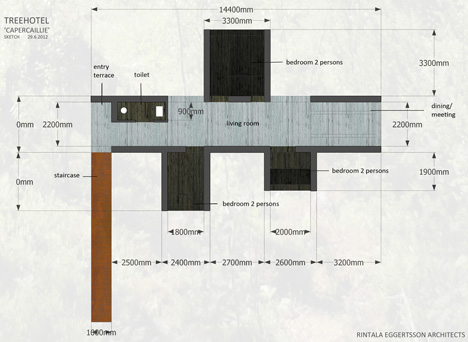
News: Finnish studio Rintala Eggertsson Architects is constructing a twenty-ton treehouse for Swedish hotel Treehotel.
Named the Five Leaf Clover, the structure will join the cluster of treehouse hotel rooms that make up the Treehotel, which is located amongst the forests in Harads, northern Sweden.
The room was designed by Rintala Eggertsson Architects to be the largest of the Treehotel’s six treehouses. At twenty tons, it will be almost three times as heavy as the seven-ton Cabin room and construction is already underway.

“At Treehotel we always strive to push limits with our environmental work, architecture and engineering,” said co-founder Kent Lindvall. “The Five Leaf Clover is clear evidence of this, as nothing remotely similar has ever been done before.”
The building will be attached to six pine trees and hover six metres above the ground, so visitors will have to climb a two-storey-high staircase to enter.

The 53-square-metre suite will contain three bedrooms and will sleep up to six guests, but could also be used as a conference room for up to twelve people. The exterior is being clad in weathered steel, while the interior is being lined with plywood.
The project is due to complete before Christmas.
Other treehouse hotel rooms at the Treehotel include a huge nest with a retractable staircase and a suspended box covered in mirrors.
http://www.dezeen.com/2012/11/15/twenty-ton-treehouse-under-construction-in-sweden/

An of updates from a recent posts

Montana tells lawmaker gold is for fools

A Montana state lawmaker’s request to be paid in gold and silver coins has been denied by the state.
Earlier this week, state Rep. Jerry O’Neil wrote the state legislature asking to be paid his annual $7,000 salary in coins because constituents in his district told him he wasn’t doing his duty to uphold the U.S. Constitution, which O’Neil and Gold standard supporters say requires the government only print gold-backed money.

http://www.politico.com/news/stories/1112/83915.html#ixzz2CPLbHxrj

Does this suprise anyone, they ought to at least know what they are going to follow

Pelosi: 'Is it the 11th Amendment? 14th? Whatever... I'm With the Constitution'


House Minority Leader Rep. Nancy Pelosi (D-CA) holds her regular weekly press briefing and displays a disturbing lack of knowledge of the constitution she has sworn for decades to protect and defend.


http://www.breitbart.com/Breitbart-TV/2012/11/16/Pelosi-Displays-Frightening-Lack-of-Knowleg-on-Amendments-of-the-Constitution

Thursday, July 29, 2010

Thursday 07-29-10


Doomsday shelters making a comeback

Jason Hodge, father of four children from Barstow, Calif., says he's "not paranoid" but he is concerned, and that's why he bought space in what might be labeled a doomsday shelter.
Hodge bought into the first of a proposed nationwide group of 20 fortified, underground shelters — the Vivos shelter network — that are intended to protect those inside for up to a year from catastrophes such as a nuclear attack, killer asteroids or tsunamis, according to the project's developers.

"It's an investment in life," says Hodge, a Teamsters union representative. "I want to make sure I have a place I can take me and my family if that worst-case scenario were to happen."

There are signs that underground shelters, almost-forgotten relics of the Cold War era, are making a comeback.

The Vivos network, which offers partial ownerships similar to a timeshare in underground shelter communities, is one of several ventures touting escape from a surface-level calamity.

Radius Engineering in Terrell, Texas, has built underground shelters for more than three decades, and business has never been better, says Walton McCarthy, company president.

The company sells fiberglass shelters that can accommodate 10 to 2,000 adults to live underground for one to five years with power, food, water and filtered air, McCarthy says.

The shelters range from $400,000 to a $41 million facility Radius built and installed underground that is suitable for 750 people, McCarthy says. He declined to disclose the client or location of the shelter.

"We've doubled sales every year for five years," he says.Other shelter manufacturers include Hardened Structures of Colorado and Utah Shelter Systems, which also report increased sales.

The shelters have their critics. Ken Rose, a history professor at California State University-Chico and author of One Nation Underground: The Fallout Shelter in American Culture, says underground shelters were a bad idea a half-century ago and they're a bad idea now.

"A terrorist with a nuke in a suitcase pales in comparison to what the Cold War had to offer in the 1950s and '60s, which was the potential annihilation of the human race," he says.

Steve Davis, president of Maryland-based All Hands Global Emergency Management Consulting, also is skeptical.

All Hands has helped more than 100 public and private sector clients with emergency management and homeland security services, according to its website.

The types of cataclysms envisioned by some shelter manufacturers "are highly unlikely compared to what we know is going to happen," Davis says.

"We know there is going to be a major earthquake someday on the West Coast. We know a hurricane is going to hit Florida, the Gulf Coast, the East Coast," he says. "We support reasonable preparedness. We don't think it's necessary to burrow into the desert."

The Vivos network is the idea of Del Mar, Calif., developer Robert Vicino.

Vicino, who launched the Vivos project last December, says he seeks buyers willing to pay $50,000 for adults and $25,000 for children.

The company is starting with a 13,000-square-foot refurbished underground shelter formerly operated by the U.S. government at an undisclosed location near Barstow, Calif., that will have room for 134 people, he says.

Vicino puts the average cost for a shelter at $10 million.

Vivos plans for facilities as large as 100,000 square feet, says real estate broker Dan Hotes of Seattle, who over the past four years has collaborated with Vicino on a project involving partial ownership of high-priced luxury homes and is now involved with Vivos.

Catastrophe shelters today may appeal to those who seek to bring order to a world full of risk and uncertainty, says Alexander Riley, an associate professor of sociology at Bucknell University in Lewisburg, Pa.

"They're saying, 'I can control everything,' " Riley says. " 'With the right amount of rational planning, I can even survive an asteroid hitting the Earth that causes a dust cloud like the kind we believe wiped the dinosaurs out.' "

The Vivos website features a clock counting down to Dec. 21, 2012, the date when the ancient Mayan "Long Count" calendar marks the end of a 5,126-year era, at which time some people expect an unknown apocalypse.

Vicino, whose terravivos.com website lists 11 global catastrophes ranging from nuclear war to solar flares to comets, bristles at the notion he's profiting from people's fears.

"You don't think of the person who sells you a fire extinguisher as taking advantage of your fear," he says. "The fact that you may never use that fire extinguisher doesn't make it a waste or bad.

"We're not creating the fear; the fear is already out there. We're creating a solution."

http://www.usatoday.com/news/nation/2010-07-28-doomsday28_ST_N.htm


Hope that you never have to go through this but you ouight to know what your rights are.

House Passes Bill to Keep Creditors From Taking Guns
If you file for bankruptcy, you run the risk of losing your money and your car to creditors.

But under a measure that just overwhelmingly passed the House of Representatives, one thing they would not be able to take is your gun.

The House this afternoon passed a bill that would change the law to allow someone going through bankruptcy proceedings to retain their rifles, shotguns, and pistols so long as they are worth less than $3,000 combined. (CBS Radio Capitol Hill correspondent Bob Fuss reports that, under the law, if you keep just one firearm, there is no such limit on its value.)

Sen. Patrick Leahy, D-VT, introduced a similar measure in the Senate yesterday. The bill passed the House 307 to 113.

The House measure was introduced by freshman Democratic Rep. John Boccieri of Ohio, who argues that "We must protect the rights guaranteed to us by our founding fathers, no matter what financial circumstances a citizen might face," according to The Plain Dealer.

The National Rifle Association, possibly the most powerful lobbying group in Washington, endorsed the measure, saying in part, "We think it is reasonable for folks who are in financial distress to have an effective means of defending themselves."

Many states already have carve-outs for firearms in bankruptcy proceedings.

New York Democratic Rep. Carolyn McCarthy argued on the House floor that the measure is a mistake, the Plain Dealer reports, arguing that having guns in households that are going through bankruptcy could increase the risks of suicide and violence.

http://www.cbsnews.com/8301-503544_162-20011999-503544.html